


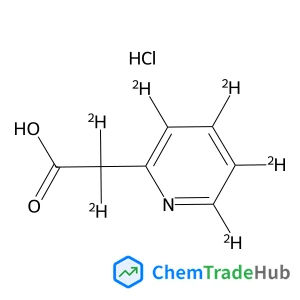
2,2-dideuterio-2-(3,4,5,6-tetradeuterio-2-pyridyl)acetic acid;hydrochloride
CAS番号:
1329799-67-8
分子式:
C7H2ClD6NO2
Lili Qiu, Mercedes Taravillo, Valentín G. Baonza, M. Carmen Ruiz Delgado, Shigeru Yamago, Ramesh Jasti, Juan T. López Navarrete, Juan Casado, Miklos Kertesz
Cyclic paraphenylenes, [n]CPPs, and linear paraphenylenes, [n]LPPs, formed by n benzenes, are investigated by Raman spectroscopy for n = 5 to 12 and density functional theory (DFT) for n = 4 to 20. The information on the experimental Raman frequencies and intensities, combined with DFT computations and reported X-ray diffraction structures, provides a consistent interpretation of the Raman spectra and allows establishing relevant structure–property trends. Structural and electronic effects such as benzene ring bending, inter-ring torsions, π-conjugation (aromaticity) and orbital energy gaps as a function of the linear elongation in [n]LPPs versus the macrocyclic curvature in [n]CPPs and of the molecular size (i.e., polymer limit) are systematically analyzed on the basis of the vibrational Raman properties. Changes in the BLA as an indicator of the degree of quinonoid character are analyzed and linked to the Effective Conjugation Coordinate (ECC) model. The BLA patterns involved in twisted and non-twisted conformations and in different species (bipolarons, quinonoid tautomers, and ECC active modes) are compared and their differences are discussed. This paper offers a unified interpretation of structural and electronic aspects in relation to the evolution from linear 1D π-systems to cyclic 2D structures.

Chemical Communications

Journal of Natural Medicines

Saudi Pharmaceutical Journal

Organic Process Research & Development

Chemistry Education Research and Practice

Current Opinion in Solid State & Materials Science

Russian Journal of Bioorganic Chemistry

Journal of Peptide Science

Acta Materialia

Drug Discovery Today
DOI: 10.1039/A809238I
Prantik Mondal, Thomas Becker, Richard Hoogenboom, Andrew B. Lowe, Nikhil K. Singha
DOI: 10.1039/D0PY01522A
László J. Csányi, Károly Jáky, István Pálinkó, Antal Rockenbauer, László Korecz
DOI: 10.1039/B002558P
DOI: 10.1039/B004184J
CAS番号163217-74-1の「邻羟基阿托伐他汀内酯标准品」は、GHS分類では危険物に分類されず、主にREACH規則とFDA/EPAの管理対象となります。R...
メチル(3R)-3-アミノ-2,3-ジヒドロ-1-ベンゾファンラニン-5-カルボイル酸塩塩酸塩は、医薬品や合成化学の研究に広く用いられます。また、特定の薬物の前...
トランス-4-メチルピロリジン-3-オール塩酸塩は、4-メチルピロリジンの塩酸塩化によって合成されます。一般的な合成方法では、4-メチルピロリジンを塩酸に加えて...
硫雜環丁烷-1,1-二氧化物は安全ではありません。毒性は報告されていませんが、高温下で分解し、可燃性があるため、高圧ガスは注意が必要です。密閉した容器で保管し、...
9-ヒドロキシエリプチシネ塩酸塩は、エリプチシネから塩酸を添加することで合成されます。選択性は高いですが、収率は約70%です。
5-塩素-2-(メチルアミノ)フェニル-(2-塩素フェニル)メタン酮のCAS番号は5621-86-3です。この化合物は白色の結晶性粉末で、分子量は415.03で...
1-[2-(4-甲氧基-苯氧基)-乙基]-哌嗪は、直射日光を避けて暗所に、室温(15-25℃)で保管し、密閉容器に入れることで安定性を保つことができます。
2-[3-(4-甲氧基フェニル)プロピル]-4,4,5,5-四メチル-1,3,2-ドイボロロールアンは、医薬品の合成、有機合成化学、および新材料の研究で使用され...

Physical Chemistry Chemical Physics (PCCP) is an international journal co-owned by 19 physical chemistry and physics societies from around the world. This journal publishes original, cutting-edge research in physical chemistry, chemical physics and biophysical chemistry. To be suitable for publication in PCCP, articles must include significant innovation and/or insight into physical chemistry; this is the most important criterion that reviewers and Editors will judge against when evaluating submissions. The journal has a broad scope and welcomes contributions spanning experiment, theory, computation and data science. Topical coverage includes spectroscopy, dynamics, kinetics, statistical mechanics, thermodynamics, electrochemistry, catalysis, surface science, quantum mechanics, quantum computing and machine learning. Interdisciplinary research areas such as polymers and soft matter, materials, nanoscience, energy, surfaces/interfaces, and biophysical chemistry are welcomed if they demonstrate significant innovation and/or insight into physical chemistry. Joined experimental/theoretical studies are particularly appreciated when complementary and based on up-to-date approaches.
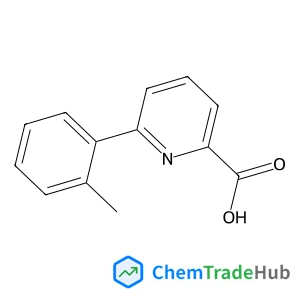
phosphoryl}methyl 4-methylbenzenesulfonate structure](https://static.chemtradehub.com/structs/864/864068-45-1-ba7c.webp "{[3-(Hexadecyloxy)propoxy](hydroxy)phosphoryl}methyl 4-methylbenzenesulfonate structure")
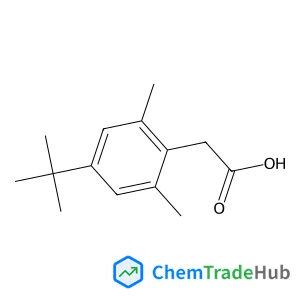
![N-[2-(4-Hydroxyphenoxy)-4-nitrophenyl]methanesulfonamide structure](https://static.chemtradehub.com/structs/109/109032-22-6-7c88.webp "N-[2-(4-Hydroxyphenoxy)-4-nitrophenyl]methanesulfonamide structure")






