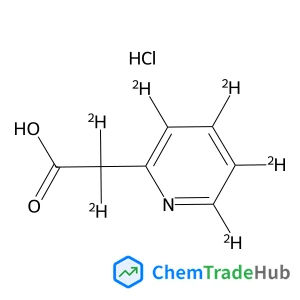
2,2-dideuterio-2-(3,4,5,6-tetradeuterio-2-pyridyl)acetic acid;hydrochloride
CAS番号:
1329799-67-8
分子式:
C7H2ClD6NO2
Masao Kamimura, Yoshihisa Shimizu, Shota Yamamoto, Kazuo Yamaguchi, Jun Nakanishi
Cell migration is an essential cellular activity in various physiological and pathological processes, such as wound healing and cancer metastasis. Therefore, in vitro cell migration assays are important not only for fundamental biological studies but also for evaluating potential drugs that control cell migration activity in medical applications. In this regard, robust control over cell migrating microenvironments is critical for reliable and quantitative analysis as cell migration is highly dependent upon the microenvironments. Here, we developed a facile method for making a commercial glass-bottom 96-well plate photoactivatable for cell adhesion, aiming to develop a versatile and multiplex cell migration assay platform. Cationic poly-D-lysine was adsorbed to the anionic glass surface via electrostatic interactions and, subsequently, functionalized with poly(ethylene glycol) (PEG) bearing a photocleavable reactive group. The initial PEGylated surface is non-cell-adhesive. However, upon near-ultraviolet (UV) irradiation, the photorelease of PEG switches the surface from non-biofouling to cell-adhesive. With this platform, we assayed cell migration in the following procedure: (1) create cell-attaching regions of precise geometries by controlled photoirradiation, (2) seed cells to allow them to attach selectively to the irradiated regions, (3) expose UV light to the remaining PEGylated regions to extend the cell-adhesive area, (4) analyse cell migration using microscopy. Surface modification of the glass surface was characterized by ζ-potential and contact angle measurements. The PEGylated surface showed cell-resistivity and became cell-adhesive upon releasing PEG by near-UV irradiation. The method was applied for parallelly evaluating the effect of model drugs on the migration of epithelial MDCK cells in the multiplexed platform. The dose–response relationship for cytochalasin D treatment on cell migration behavior was successfully evaluated with high reproducibility. Interestingly, the impact of blebbistatin on cell migration was dependent upon the widths of the migrating regions, resulting in both cases of migration acceleration and deceleration. These results clearly demonstrate that the cellular response to certain drugs is highly affected by their migrating geometries. Therefore, the obtained novel photoactivatable 96-well plate serves as a useful high-throughput platform for the identification of drug candidates that have an effect on cell migration behavior.
Boris Kharkov, Xueyou Duan, Emily S. Tovar, James W. Canary, Alexej Jerschow
DOI: 10.1039/C8CP06883F
Rudramani Pokhrel, Elumalai Pavadai
DOI: 10.1039/C8CP07323F
Wen-Hua Yang, Shan-Dong Li, Xu-Yan Xue, Qing-Jun Zang, K. M. Ho, C. Z. Wang
DOI: 10.1039/C9CP00310J
K. Develos-Bagarinao, J. De Vero, H. Kishimoto, T. Ishiyama, K. Yamaji, T. Horita
DOI: 10.1039/C9CP00606K
Xiaodan Cao, Changcheng Zhang, Ziheng Gao, Yangyi Liu, Yuzheng Zhao, Yi Yang
DOI: 10.1039/C8CP07553K
David Ibáñez, Alejandro Pérez-Junquera, María Begoña González-García, David Hernández-Santos, Pablo Fanjul-Bolado
DOI: 10.1039/C9CP00484J
Xin Xiang, Guikai Zhang, Feilong Yang, Tao Tang
DOI: 10.1039/C8CP07187J
Leonid S. Khaikin, Igor V. Kochikov, Anatoliy N. Rykov, Olga E. Grikina, Georgiy G. Ageev, Igor F. Shishkov, Vladimir V. Kuznetsov, Nina N. Makhova
DOI: 10.1039/C8CP07607C
Jingwei Liu, Guangtao Yu, Ran Zhang, Xuri Huang, Wei Chen
DOI: 10.1039/C9CP00618D
CAS番号163217-74-1の「邻羟基阿托伐他汀内酯标准品」は、GHS分類では危険物に分類されず、主にREACH規則とFDA/EPAの管理対象となります。R...
メチル(3R)-3-アミノ-2,3-ジヒドロ-1-ベンゾファンラニン-5-カルボイル酸塩塩酸塩は、医薬品や合成化学の研究に広く用いられます。また、特定の薬物の前...
トランス-4-メチルピロリジン-3-オール塩酸塩は、4-メチルピロリジンの塩酸塩化によって合成されます。一般的な合成方法では、4-メチルピロリジンを塩酸に加えて...
硫雜環丁烷-1,1-二氧化物は安全ではありません。毒性は報告されていませんが、高温下で分解し、可燃性があるため、高圧ガスは注意が必要です。密閉した容器で保管し、...
9-ヒドロキシエリプチシネ塩酸塩は、エリプチシネから塩酸を添加することで合成されます。選択性は高いですが、収率は約70%です。
5-塩素-2-(メチルアミノ)フェニル-(2-塩素フェニル)メタン酮のCAS番号は5621-86-3です。この化合物は白色の結晶性粉末で、分子量は415.03で...
1-[2-(4-甲氧基-苯氧基)-乙基]-哌嗪は、直射日光を避けて暗所に、室温(15-25℃)で保管し、密閉容器に入れることで安定性を保つことができます。
2-[3-(4-甲氧基フェニル)プロピル]-4,4,5,5-四メチル-1,3,2-ドイボロロールアンは、医薬品の合成、有機合成化学、および新材料の研究で使用され...

Physical Chemistry Chemical Physics (PCCP) is an international journal co-owned by 19 physical chemistry and physics societies from around the world. This journal publishes original, cutting-edge research in physical chemistry, chemical physics and biophysical chemistry. To be suitable for publication in PCCP, articles must include significant innovation and/or insight into physical chemistry; this is the most important criterion that reviewers and Editors will judge against when evaluating submissions. The journal has a broad scope and welcomes contributions spanning experiment, theory, computation and data science. Topical coverage includes spectroscopy, dynamics, kinetics, statistical mechanics, thermodynamics, electrochemistry, catalysis, surface science, quantum mechanics, quantum computing and machine learning. Interdisciplinary research areas such as polymers and soft matter, materials, nanoscience, energy, surfaces/interfaces, and biophysical chemistry are welcomed if they demonstrate significant innovation and/or insight into physical chemistry. Joined experimental/theoretical studies are particularly appreciated when complementary and based on up-to-date approaches.