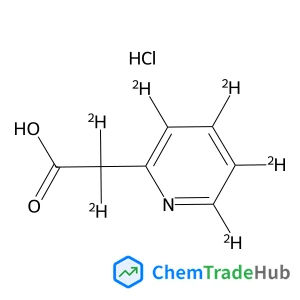
2,2-dideuterio-2-(3,4,5,6-tetradeuterio-2-pyridyl)acetic acid;hydrochloride
CAS番号:
1329799-67-8
分子式:
C7H2ClD6NO2
Heike L. K. S. Mosch, Stephanie Höppener, Renzo M. Paulus, Bernd Schröter, Ulrich S. Schubert, Anna Ignaszak
Carbon–polymer composites have great application potential in the field of organic batteries, capacitors, capacitive water desalination reactors and as the conductive platforms for electrochemical sensors. Although numerous studies have been carried out with respect to the synthesis, the optimization of composition, the carbon type and the morphology control, there is still a lack of understanding about which kind of intermolecular connection between carbon and polymer phases is preferential, and how the system should be designed to achieve the application demand of long-term electrochemical stability. Herein, we propose two model systems that employ the most well-known commercial carbons (SWCNTs and carbon black Vulcan XC72-R) to generate polypyrrole–C composites and validate the type of chemical bonding that is preferential to maintain electrochemical stability. In this work we used a simple oxidative polymerization of pyrrole and generated various formulations (with variable polymer content). Based on the surface XPS combined with bulk TGA-MS analysis we were able to evaluate the concentration and type of oxygen-containing functionalities, revealing a high oxygen content for the carbon black. It was further correlated with XPS analysis of the respective composites showed evidence of the electronic interaction called π–π* stacking between SWCNTs and PPy, and the binding energy shifts associated with the formation of hydrogen bridge bonds in the case of Vulcan XC-72R-PPy. Furthermore, the electrochemical stability of these model samples was investigated by AC impedance spectroscopy. The charge transfer resistance (Rct) was analyzed upon the oxidative potential, revealing SWCNT–PPy as an ultra-stable composite, even for the high polymer content (1 : 4 weight ratio of C–PPy). In contrast, the carbon black–PPy underwent rapid degradation in the whole composition range. The durability is associated with the type and strength of the polymer–carbon bonding as revealed by EIS impedance correlated with spectroscopic studies. The electronic interactions between SWCNTs and PPy result in superior stability while the carbon black–PPy, where the hydrogen bridge bonds are generated, is not stable under the same experimental conditions.
Akarsh Verma, Rajesh Kumar, Avinash Parashar
DOI: 10.1039/C9CP00362B
Rudramani Pokhrel, Elumalai Pavadai
DOI: 10.1039/C8CP07323F
Xiaodan Cao, Changcheng Zhang, Ziheng Gao, Yangyi Liu, Yuzheng Zhao, Yi Yang
DOI: 10.1039/C8CP07553K
Simon Mathieu, Georges Trinquier
DOI: 10.1039/C8CP07321J
Haina Wang, Ryan P. A. Bettens
DOI: 10.1039/C8CP07640E
DOI: 10.1039/C8CP07132B
Simuck F. Yuk, Valentino R. Cooper
DOI: 10.1039/C8CP02405G
Roman Bertoni, Eric Collet, Hervé Cailleau, Marie-Laure Boillot, Antoine Tissot, Jérôme Laisney, Cristian Enachescu, Maciej Lorenc
DOI: 10.1039/C8CP07074A
Kai Li, Rik Van Deun
DOI: 10.1039/C9CP90014D
CAS番号163217-74-1の「邻羟基阿托伐他汀内酯标准品」は、GHS分類では危険物に分類されず、主にREACH規則とFDA/EPAの管理対象となります。R...
メチル(3R)-3-アミノ-2,3-ジヒドロ-1-ベンゾファンラニン-5-カルボイル酸塩塩酸塩は、医薬品や合成化学の研究に広く用いられます。また、特定の薬物の前...
トランス-4-メチルピロリジン-3-オール塩酸塩は、4-メチルピロリジンの塩酸塩化によって合成されます。一般的な合成方法では、4-メチルピロリジンを塩酸に加えて...
硫雜環丁烷-1,1-二氧化物は安全ではありません。毒性は報告されていませんが、高温下で分解し、可燃性があるため、高圧ガスは注意が必要です。密閉した容器で保管し、...
9-ヒドロキシエリプチシネ塩酸塩は、エリプチシネから塩酸を添加することで合成されます。選択性は高いですが、収率は約70%です。
5-塩素-2-(メチルアミノ)フェニル-(2-塩素フェニル)メタン酮のCAS番号は5621-86-3です。この化合物は白色の結晶性粉末で、分子量は415.03で...
1-[2-(4-甲氧基-苯氧基)-乙基]-哌嗪は、直射日光を避けて暗所に、室温(15-25℃)で保管し、密閉容器に入れることで安定性を保つことができます。
2-[3-(4-甲氧基フェニル)プロピル]-4,4,5,5-四メチル-1,3,2-ドイボロロールアンは、医薬品の合成、有機合成化学、および新材料の研究で使用され...

Physical Chemistry Chemical Physics (PCCP) is an international journal co-owned by 19 physical chemistry and physics societies from around the world. This journal publishes original, cutting-edge research in physical chemistry, chemical physics and biophysical chemistry. To be suitable for publication in PCCP, articles must include significant innovation and/or insight into physical chemistry; this is the most important criterion that reviewers and Editors will judge against when evaluating submissions. The journal has a broad scope and welcomes contributions spanning experiment, theory, computation and data science. Topical coverage includes spectroscopy, dynamics, kinetics, statistical mechanics, thermodynamics, electrochemistry, catalysis, surface science, quantum mechanics, quantum computing and machine learning. Interdisciplinary research areas such as polymers and soft matter, materials, nanoscience, energy, surfaces/interfaces, and biophysical chemistry are welcomed if they demonstrate significant innovation and/or insight into physical chemistry. Joined experimental/theoretical studies are particularly appreciated when complementary and based on up-to-date approaches.

![N-[2-(4-Hydroxyphenoxy)-4-nitrophenyl]methanesulfonamide structure](https://static.chemtradehub.com/structs/109/109032-22-6-7c88.webp "N-[2-(4-Hydroxyphenoxy)-4-nitrophenyl]methanesulfonamide structure")