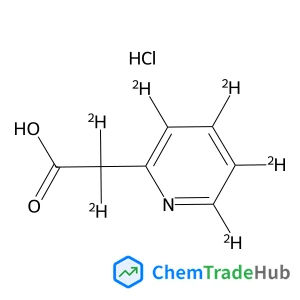
2,2-dideuterio-2-(3,4,5,6-tetradeuterio-2-pyridyl)acetic acid;hydrochloride
CAS番号:
1329799-67-8
分子式:
C7H2ClD6NO2
Alison L. McManus, Erik P. Hoy, David A. Mazziotti
The treatment of biradical chemistry presents a challenge for electronic structure theory, especially single-reference methods, as it requires the description of varying degrees and kinds of electron correlation. In this work we assess the ability of the parametric two-electron reduced-density matrix (p2-RDM) method to describe biradical chemistry through application to the benzene and cyclobutadiene biradicals. The relative energy of o- and m-benzynes predicted by the p2-RDM method is consistent with Wenthold et al.'s experimental determinations, while the more difficult relative energy prediction of the more multi-referenced p-benzyne is within 1.4 kcal mol−1 of the experimental value [P. G. Wenthold et al., J. Am. Chem. Soc., 1998, 120, 5279], which is significantly better than traditional single-reference methods. We observe that the degree of multireference correlation in the biradicals depends upon the distance between their radical centers, with the largest radical separation displaying the largest degree of multireference correlation. In addition to relative and absolute electronic energies, we report molecular geometries, natural orbitals, and natural-orbital occupations for the benzene and cyclobutadiene biradicals.
Xiaosong Chen, Suna Zhang, Kunjie Wu, Hongwei Li, Yancheng Meng, Liqiang Li
DOI: 10.1039/C6CP00756B
Prabhat Gautam, Rajneesh Misra, Subhayan Biswas, Ganesh D. Sharma
DOI: 10.1039/C6CP01163B
Ketan Sharma, Bretislav Friedrich
DOI: 10.1039/C6CP00390G
V. Sáez-Rábanos, J. E. Verdasco, F. J. Aoiz, V. J. Herrero
DOI: 10.1039/C6CP01305H
DOI: 10.1039/C6CP01747A
Corina H. Pollok, Christian Merten
DOI: 10.1039/C6CP01946C
Paramita Banerjee, Prasanta K. Nandi
DOI: 10.1039/C5CP07661G
Aabhash Shrestha, Shi Zhang Qiao, Sheng Dai
DOI: 10.1039/C6CP02119K
J. Martinez-Asencio, C. J. Ruestes, E. M. Bringa, M. J. Caturla
DOI: 10.1039/C6CP01487A
CAS番号163217-74-1の「邻羟基阿托伐他汀内酯标准品」は、GHS分類では危険物に分類されず、主にREACH規則とFDA/EPAの管理対象となります。R...
メチル(3R)-3-アミノ-2,3-ジヒドロ-1-ベンゾファンラニン-5-カルボイル酸塩塩酸塩は、医薬品や合成化学の研究に広く用いられます。また、特定の薬物の前...
トランス-4-メチルピロリジン-3-オール塩酸塩は、4-メチルピロリジンの塩酸塩化によって合成されます。一般的な合成方法では、4-メチルピロリジンを塩酸に加えて...
硫雜環丁烷-1,1-二氧化物は安全ではありません。毒性は報告されていませんが、高温下で分解し、可燃性があるため、高圧ガスは注意が必要です。密閉した容器で保管し、...
9-ヒドロキシエリプチシネ塩酸塩は、エリプチシネから塩酸を添加することで合成されます。選択性は高いですが、収率は約70%です。
5-塩素-2-(メチルアミノ)フェニル-(2-塩素フェニル)メタン酮のCAS番号は5621-86-3です。この化合物は白色の結晶性粉末で、分子量は415.03で...
1-[2-(4-甲氧基-苯氧基)-乙基]-哌嗪は、直射日光を避けて暗所に、室温(15-25℃)で保管し、密閉容器に入れることで安定性を保つことができます。
2-[3-(4-甲氧基フェニル)プロピル]-4,4,5,5-四メチル-1,3,2-ドイボロロールアンは、医薬品の合成、有機合成化学、および新材料の研究で使用され...

Physical Chemistry Chemical Physics (PCCP) is an international journal co-owned by 19 physical chemistry and physics societies from around the world. This journal publishes original, cutting-edge research in physical chemistry, chemical physics and biophysical chemistry. To be suitable for publication in PCCP, articles must include significant innovation and/or insight into physical chemistry; this is the most important criterion that reviewers and Editors will judge against when evaluating submissions. The journal has a broad scope and welcomes contributions spanning experiment, theory, computation and data science. Topical coverage includes spectroscopy, dynamics, kinetics, statistical mechanics, thermodynamics, electrochemistry, catalysis, surface science, quantum mechanics, quantum computing and machine learning. Interdisciplinary research areas such as polymers and soft matter, materials, nanoscience, energy, surfaces/interfaces, and biophysical chemistry are welcomed if they demonstrate significant innovation and/or insight into physical chemistry. Joined experimental/theoretical studies are particularly appreciated when complementary and based on up-to-date approaches.