


Carbon nanospikes grown on metal wires as microelectrode sensors for dopamine
文献情報
出版日
2015-09-14
DOI
10.1039/C5AN01467K
インパクトファクター
4.616
著者
Alexander G. Zestos, Cheng Yang, Dale Hensley, B. Jill Venton
原文を見る
要旨
Carbon nanomaterials are advantageous as electrodes for neurotransmitter detection, but the difficulty of nanomaterials deposition on electrode substrates limits the reproducibility and future applications. In this study, we used plasma enhanced chemical vapor deposition (PECVD) to directly grow a thin layer of carbon nanospikes (CNS) on cylindrical metal substrates. No catalyst is required and the CNS surface coverage is uniform over the cylindrical metal substrate. The CNS growth was characterized on several metallic substrates including tantalum, niobium, palladium, and nickel wires. Using fast-scan cyclic voltammetry (FSCV), bare metal wires could not detect 1 μM dopamine while carbon nanospike coated wires could. The highest sensitivity and optimized S/N ratio was recorded from carbon nanospike-tantalum (CNS-Ta) microwires grown for 7.5 minutes, which had a LOD of 8 ± 2 nM for dopamine with FSCV. CNS-Ta microelectrodes were more reversible and had a smaller ΔEp for dopamine than carbon-fiber microelectrodes, suggesting faster electron transfer kinetics. The kinetics of dopamine redox were adsorption controlled at CNS-Ta microelectrodes and repeated electrochemical measurements displayed stability for up to ten hours in vitro and over a ten day period as well. The oxidation potential was significantly different for ascorbic acid and uric acid compared to dopamine. Growing carbon nanospikes on metal wires is a promising method to produce uniformly-coated, carbon nanostructured cylindrical microelectrodes for sensitive dopamine detection.
おすすめジャーナル

Journal of Natural Medicines

New Journal of Chemistry

Journal of Saudi Chemical Society

Russian Journal of Bioorganic Chemistry

Drug Discovery Today

Journal of Peptide Science

Russian Journal of Coordination Chemistry

Russian Journal of General Chemistry

Russian Journal of Organic Chemistry

Saudi Pharmaceutical Journal
関連文献
Distribution of zwitter-ionic tryptophan between the micelles of 1-dodecyl-3-methyl imidazolium and aqueous medium from molecular dynamic simulation
Elena A. Belyaeva, Aleksandr A. Vanin, Alexey I. Victorov
2018-08-29
Paper
DOI: 10.1039/C8CP02488J
Permeation pathways through lateral domains in model membranes of skin lipids
Annalaura Del Regno, Rebecca Notman
2017-11-08
Paper
DOI: 10.1039/C7CP03258G
Photodissociation dynamics of bromoiodomethane from the first and second absorption bands. A combined velocity map and slice imaging study
David V. Chicharro, Eduardo Navarro, Luis Rubio-Lago, Luis Bañares
2018-01-03
Paper
DOI: 10.1039/C7CP07077B
Photoexcited charge carrier dynamics of interconnected TiO2 nanoparticles: evidence of enhancement of charge separation at anatase–rutile particle interfaces
Daiki Shingai, Yusuke Ide, Woon Yong Sohn
2018-01-03
Paper
DOI: 10.1039/C7CP07563D
A rechargeable aluminum-ion battery based on a VS2 nanosheet cathode
Lu Wu, Ruimin Sun, Fangyu Xiong, Cunyuan Pei, Kang Han, Chen Peng, Yuqi Fan, Wei Yang, Qinyou An, Liqiang Mai
2018-08-22
Paper
DOI: 10.1039/C8CP04772C
A synergic approach of X-ray powder diffraction and Raman spectroscopy for crystal structure determination of 2,3-thienoimide capped oligothiophenes
C. Cappuccino, T. Salzillo, E. Venuti, A. Giunchi, R. G. Della Valle, A. Brillante, C. Bettini, M. Melucci, L. Maini
2018-01-02
Paper
DOI: 10.1039/C7CP06679A
Non-Gaussianity, population heterogeneity, and transient superdiffusion in the spreading dynamics of amoeboid cells
Andrey G. Cherstvy, Oliver Nagel, Carsten Beta, Ralf Metzler
2018-08-08
Paper
DOI: 10.1039/C8CP04254C
Nanoparticle-induced ion-sensitive reduction in decane–water interfacial tension
Boyao Wen, Chengzhen Sun, Bofeng Bai
2018-08-08
Paper
DOI: 10.1039/C8CP04041A
Borophene's tryst with stability: exploring 2D hydrogen boride as an electrode for rechargeable batteries
Vivekanand Shukla, Rafael B. Araujo, Naresh K. Jena
2018-08-01
Paper
DOI: 10.1039/C8CP03686A
こちらもおすすめ
化合物よくある質問
4-アミノフェノール酸ナトリウム水和物とは何ですか?
4-アミノフェノール酸ナトリウム水和物は、CAS番号206557-08-6の化合物で、4-アミノフェノールとナトリウムが結合した塩と水和物です。この化合物は、白...
206557-08-64-Aminobenzoic acid ...
化合物よくある質問
Methyl 3-methyl-N-{[(2-methyl-2-propanyl)oxy]carbonyl}-L-histidinateの代替品はありますか?
この化合物は特定の合成プロセスに使用される可能性がありますが、代替品として、他の类似的な化合物、例えばMethyl 3-methyl-N-{[(2-methyl...
72212-51-2Methyl 3-methyl-N-{[...
化合物よくある質問
4-Boc-2-哌嗪甲酸の市場動向や研究トレンドはどうですか?
4-Boc-2-哌嗪甲酸は、薬品開発や合成化学分野で広く使用されており、その需要は継続的に推移しています。特に、新薬開発における合成化学分野での需要が高まってい...
192330-11-3(2R)-4-[(tert-butoxy...
化合物よくある質問
4,4'-二羟甲基联苯の物理化学的性質は何ですか?
4,4'-二羟甲基联苯のCAS番号は1667-12-5です。この化合物は白色の結晶粉末で、分子量は154.20です。水にわずかに溶けますが、アルコールや有機溶媒...
1667-12-54,4'-Biphenyldiyldim...
化合物よくある質問
5-甲硫基戊腈はどの業界で使用されていますか?
5-甲硫基戊腈は医薬品産業で使用される可能性があります。また、ポリマー合成の触媒として、センサー製造の一部として、半導体製造のプロセス改善に使用される可能性があ...
59121-25-45-(Methylsulfanyl)pe...
化合物よくある質問
CAS番号1311961-50-8の化合物はどのように合成されますか?
この化合物は、1-abieta-8,11,13-trien-19-イルと6'-メトキシシンコナナン-9-基を含有する窒素含有化合物から合成されます。一般的な合成...
1311961-50-81-Abieta-8,11,13-tri...
化合物よくある質問
6-ブロモベンジジミダゾール-2-カルビルデオキシドはどのように保存すればよいですか?
6-ブロモベンジジミダゾール-2-カルビルデオキシドは、避光・乾燥した容器(密閉容器)で-20℃~4℃の低温で保存してください。高温や直射日光、湿気は避けてくだ...
885280-26-25-Bromo-1H-benzimida...
化合物よくある質問
Boc-N-甲基氨甲环酸とは何ですか?
621-65-8のCAS番号を持つBoc-N-甲基氨甲环酸は、化学式C7H13NO5を有する化合物です。この化合物は白色の結晶性粉末で、吸湿性があります。
621-65-83-Hydroxy-1,2-propan...
化合物よくある質問
乙基三氟硼酸钾はどのように合成されますか?
乙基三氟硼酸钾は、トリフLUオール酸カリウムとエチルブロミドを反応させて合成されます。この反応は高い選択性と収率を持ち、触媒を用いることで効率的に進行します。
882871-21-8Potassium ethyltrifl...
化合物よくある質問
2-フロウロ-5-クロロ-4-アミノフェノールはどのように保存すればよいですか?
2-フロウロ-5-クロロ-4-アミノフェノールは、直射日光を避けて冷却された暗所で保存し、密閉容器に保管してください。温度は常温か低温が適しています。
847872-10-04-Amino-5-chloro-2-f...
掲載誌
Analyst

CiteScore:
7.8
自己引用率:
5.6%
年間論文数:
653
Analyst publishes analytical and bioanalytical research that reports premier fundamental discoveries and inventions, and the applications of those discoveries, unconfined by traditional discipline barriers.
おすすめ化合物

![N-{3-[Benzyl(methyl)amino]propyl}-9-chloro-5,6,7,8-tetrahydro-2-acridinecarboxamide structure](https://static.chemtradehub.com/structs/142/1426944-49-1-1e4c.webp "N-{3-[Benzyl(methyl)amino]propyl}-9-chloro-5,6,7,8-tetrahydro-2-acridinecarboxamide structure")
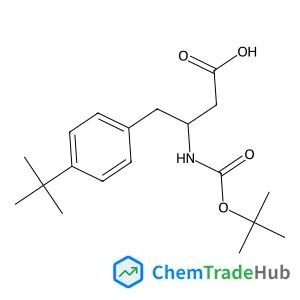
(S)-3-((tert-Butoxycarbonyl)amino)-4-(4-(tert-butyl)phenyl)butanoic acid
CAS番号:
403661-85-8
分子式:
C19H29NO4
おすすめサプライヤー






免責事項
このページに表示される学術雑誌情報は、参考および研究目的のみを目的としています。当社は雑誌出版社とは提携しておらず、投稿の取り扱いも行っておりません。出版に関するお問い合わせは、各雑誌出版社に直接ご連絡ください。
表示されている情報に誤りがある場合は、support@chemtradehub.com までご連絡ください。迅速に確認し、対応いたします。