


Experimental and theoretical investigations on temperature modulated translocation of IgG molecules through nanopore arrays
文献情報
出版日
2015-06-05
DOI
10.1039/C5AN00853K
インパクトファクター
4.616
著者
Lizhong Zhu
原文を見る
要旨
In the past few decades, nanopore based biosensing has attracted more and more attention. In this work, a novel fluidic sensor was fabricated using two separated liquid cells, which were linked by polycarbonate (PC) ultrafiltration membranes containing nanopore arrays. The trans-membrane ionic current generated by the applied voltage and the current changes modulated by a goat antibody to human immunoglobulin G (IgG) translocation were recorded simultaneously. The experimental results show that the ionic current is modulated by the physical place-holding effect generated by IgG translocation through nanopore arrays. For different temperatures (4 °C, 22 °C, and 45 °C) and different concentrations of the electrolyte (0.01 mol L−1, 0.10 mol L−1 and 1.0 mol L−1), the relative variance of the ionic current ((I0 − I)/I0) modulated by IgG translocation increases at first and then decreases and stabilizes. With the increase of the IgG concentration, there is an obvious “inflection point” corresponding to the maximum value of the relative variance of the ionic current. The concentration of the electrolyte does not affect the position of the “inflection point”, while temperature increment makes the “inflection point” shift to the high IgG concentration direction. Finally, a simplified model is suggested and the calculated results contribute to the understanding of the temperature induced IgG translocation behavior, which matches the ionic current changing tendency obtained in our experiments.
おすすめジャーナル

Russian Journal of Bioorganic Chemistry

Russian Journal of Applied Chemistry

Journal of Saudi Chemical Society

Saudi Pharmaceutical Journal

Russian Chemical Bulletin

Russian Journal of General Chemistry

Crystallography Reports

Russian Journal of Coordination Chemistry

Drug Discovery Today

Current Opinion in Solid State & Materials Science
関連文献
Methyl substitution enhanced photoisomerization of trans,trans-1,4-diphenyl-1,3-butadiene: direct ab initio trajectory surface hopping dynamic simulations
Yueqian Fan, Juan Chen, Le Yu, Anyang Li, Gaohong Zhai, Yibo Lei, Chaoyuan Zhu
2017-12-18
Paper
DOI: 10.1039/C7CP07465D
Exploration of the unusual two-step volume phase transition of the poly(N-vinylcaprolactam-co-hydroxyethyl methacrylate) hydrogel
Gehong Su, Liyang Jia, Xueqian Zhang, Yulin Zhang, Pengchi Deng, Tao Zhou
2018-08-13
Paper
DOI: 10.1039/C8CP02429D
NMR shielding constants in group 15 trifluorides
Terri E. Field-Theodore, Małgorzata Olejniczak, Michał Jaszuński, David J. D. Wilson
2018-08-21
Paper
DOI: 10.1039/C8CP04056G
Theoretical investigation of selective catalytic reduction of NO on MIL-100-Fe
2017-12-20
Paper
DOI: 10.1039/C7CP06756A
Design of donor–acceptor copolymers for organic photovoltaic materials: a computational study
Haydar Taylan Turan, Oğuzhan Kucur, Birce Kahraman, Seyhan Salman, Viktorya Aviyente
2018-01-09
Paper
DOI: 10.1039/C7CP08176F
A high pressure study of calmodulin–ligand interactions using small-angle X-ray and elastic incoherent neutron scattering
Süleyman Cinar, Samy Al-Ayoubi, Christian Sternemann, Judith Peters, Roland Winter, Claus Czeslik
2018-01-02
Paper
DOI: 10.1039/C7CP07399B
Significantly enhanced energy storage performance in BiFeO3/BaTiO3/BiFeO3 sandwich-structured films through crystallinity regulation
Renlu Han, Weiping Li, Laihui Luo, Weidong Fei
2018-08-14
Paper
DOI: 10.1039/C8CP04072A
Polymerization kinetics of a multi-functional silica precursor studied using a novel Monte Carlo simulation technique
Inderdip Shere, Ateeque Malani
2017-12-20
Paper
DOI: 10.1039/C7CP07737H
Determination of derived volumetric properties and heat capacities at high pressures using two density scaling based equations of state. Application to dipentaerythritol hexa(3,5,5-trimethylhexanoate)
E. R. López, D. Cabaleiro, J. Fernández
2018-01-08
Paper
DOI: 10.1039/C7CP07180A
Ideal inert substrates for planar antimonene: h-BN and hydrogenated SiC(0001)
Shuai Zhang, Yandong Ma, Rui Peng, Baibiao Huang, Ying Dai
2018-08-18
Paper
DOI: 10.1039/C8CP04200D
こちらもおすすめ
化合物よくある質問
4-アミノフェノール酸ナトリウム水和物とは何ですか?
4-アミノフェノール酸ナトリウム水和物は、CAS番号206557-08-6の化合物で、4-アミノフェノールとナトリウムが結合した塩と水和物です。この化合物は、白...
206557-08-64-Aminobenzoic acid ...
化合物よくある質問
Methyl 3-methyl-N-{[(2-methyl-2-propanyl)oxy]carbonyl}-L-histidinateの代替品はありますか?
この化合物は特定の合成プロセスに使用される可能性がありますが、代替品として、他の类似的な化合物、例えばMethyl 3-methyl-N-{[(2-methyl...
72212-51-2Methyl 3-methyl-N-{[...
化合物よくある質問
4-Boc-2-哌嗪甲酸の市場動向や研究トレンドはどうですか?
4-Boc-2-哌嗪甲酸は、薬品開発や合成化学分野で広く使用されており、その需要は継続的に推移しています。特に、新薬開発における合成化学分野での需要が高まってい...
192330-11-3(2R)-4-[(tert-butoxy...
化合物よくある質問
4,4'-二羟甲基联苯の物理化学的性質は何ですか?
4,4'-二羟甲基联苯のCAS番号は1667-12-5です。この化合物は白色の結晶粉末で、分子量は154.20です。水にわずかに溶けますが、アルコールや有機溶媒...
1667-12-54,4'-Biphenyldiyldim...
化合物よくある質問
5-甲硫基戊腈はどの業界で使用されていますか?
5-甲硫基戊腈は医薬品産業で使用される可能性があります。また、ポリマー合成の触媒として、センサー製造の一部として、半導体製造のプロセス改善に使用される可能性があ...
59121-25-45-(Methylsulfanyl)pe...
化合物よくある質問
CAS番号1311961-50-8の化合物はどのように合成されますか?
この化合物は、1-abieta-8,11,13-trien-19-イルと6'-メトキシシンコナナン-9-基を含有する窒素含有化合物から合成されます。一般的な合成...
1311961-50-81-Abieta-8,11,13-tri...
化合物よくある質問
6-ブロモベンジジミダゾール-2-カルビルデオキシドはどのように保存すればよいですか?
6-ブロモベンジジミダゾール-2-カルビルデオキシドは、避光・乾燥した容器(密閉容器)で-20℃~4℃の低温で保存してください。高温や直射日光、湿気は避けてくだ...
885280-26-25-Bromo-1H-benzimida...
化合物よくある質問
Boc-N-甲基氨甲环酸とは何ですか?
621-65-8のCAS番号を持つBoc-N-甲基氨甲环酸は、化学式C7H13NO5を有する化合物です。この化合物は白色の結晶性粉末で、吸湿性があります。
621-65-83-Hydroxy-1,2-propan...
化合物よくある質問
乙基三氟硼酸钾はどのように合成されますか?
乙基三氟硼酸钾は、トリフLUオール酸カリウムとエチルブロミドを反応させて合成されます。この反応は高い選択性と収率を持ち、触媒を用いることで効率的に進行します。
882871-21-8Potassium ethyltrifl...
化合物よくある質問
2-フロウロ-5-クロロ-4-アミノフェノールはどのように保存すればよいですか?
2-フロウロ-5-クロロ-4-アミノフェノールは、直射日光を避けて冷却された暗所で保存し、密閉容器に保管してください。温度は常温か低温が適しています。
847872-10-04-Amino-5-chloro-2-f...
掲載誌
Analyst

CiteScore:
7.8
自己引用率:
5.6%
年間論文数:
653
Analyst publishes analytical and bioanalytical research that reports premier fundamental discoveries and inventions, and the applications of those discoveries, unconfined by traditional discipline barriers.
おすすめ化合物
![(4aR,5S,6R,8aS)-5-[2-(3-Furyl)ethyl]-8a-(hydroxymethyl)-5,6-dimethyl-3,4,4a,5,6,7,8,8a-octahydro-1-naphthalenecarboxylic acid structure](https://static.chemtradehub.com/structs/184/18411-75-1-d4cd.webp "(4aR,5S,6R,8aS)-5-[2-(3-Furyl)ethyl]-8a-(hydroxymethyl)-5,6-dimethyl-3,4,4a,5,6,7,8,8a-octahydro-1-naphthalenecarboxylic acid structure")
![N-{3-[Benzyl(methyl)amino]propyl}-9-chloro-5,6,7,8-tetrahydro-2-acridinecarboxamide structure](https://static.chemtradehub.com/structs/142/1426944-49-1-1e4c.webp "N-{3-[Benzyl(methyl)amino]propyl}-9-chloro-5,6,7,8-tetrahydro-2-acridinecarboxamide structure")
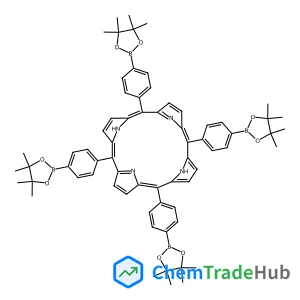
5,10,15,20-tetrakis(4-boronic acid pinacol ester phenyl) porphyrin
CAS番号:
1332748-00-1
分子式:
C68H74B4N4O8
![2-[(5Z,8Z,11Z,14Z)-5,8,11,14-Icosatetraen-1-yloxy]-1,3-propanediol structure](https://static.chemtradehub.com/structs/222/222723-55-9-0348.webp "2-[(5Z,8Z,11Z,14Z)-5,8,11,14-Icosatetraen-1-yloxy]-1,3-propanediol structure")
おすすめサプライヤー







免責事項
このページに表示される学術雑誌情報は、参考および研究目的のみを目的としています。当社は雑誌出版社とは提携しておらず、投稿の取り扱いも行っておりません。出版に関するお問い合わせは、各雑誌出版社に直接ご連絡ください。
表示されている情報に誤りがある場合は、support@chemtradehub.com までご連絡ください。迅速に確認し、対応いたします。