


A local collision probability approximation for predicting momentum transfer cross sections
文献情報
出版日
2015-07-10
DOI
10.1039/C5AN00712G
インパクトファクター
4.616
著者
原文を見る
要旨
The local collision probability approximation (LCPA) method is introduced to compute molecular momentum transfer cross sections for comparison to ion mobility experiments. The LCPA replaces the (non-local) scattering trajectory used in the trajectory method to describe the collision process by a (local) collision probability function. This momentum transfer probability is computed using the exact same analyte–buffer interaction potential as used in the trajectory method. Subsequently, the momentum transfer cross section ΩLCPA(T) is calculated in a projection-type manner (corrected for shape effects through a shape factor). Benchmark calculations on a set of 208 carbon clusters with a range of molecular size and degree of concavity demonstrate that LCPA and trajectory calculations agree closely with one another. The results discussed here indicate that the LCPA is suitable to efficiently calculate momentum transfer cross sections for use in ion mobility spectrometry in conjunction with different buffer gases.
おすすめジャーナル

Nature Medicine

Journal of Natural Medicines

Organic Process Research & Development

Russian Journal of Applied Chemistry

Journal of Peptide Science

Current Opinion in Colloid & Interface Science

Journal of Saudi Chemical Society

Russian Chemical Bulletin

Current Opinion in Solid State & Materials Science

Acta Materialia
関連文献
Water facilitates oxygen migration on gold surfaces
Fang Xu, Ioanna Fampiou, Christopher R. O'Connor, Stavros Karakalos, Fanny Hiebel, Robert J. Madix
2017-12-05
Paper
DOI: 10.1039/C7CP06451A
Mixed ether-based solvents provide a long cycle life with high rate capability to graphite anodes for Na-ion batteries
Tetsuya Kajita, Takashi Itoh
2017-11-29
Paper
DOI: 10.1039/C7CP06998G
Fragment motion in motor molecules: basic concepts and application to intra-molecular rotations
Klaus E. Hermann, Fei Qi, Rundong Zhao, Michel A. Van Hove
2018-08-02
Paper
DOI: 10.1039/C8CP03076F
The structural diversity of C-rich DNA aggregates: unusual self-assembly of beetle-like nanostructures
A. D. Protopopova, V. B. Tsvetkov, A. M. Varizhuk, N. A. Barinov, V. V. Podgorsky, D. V. Klinov, G. E. Pozmogova
2018-01-16
Paper
DOI: 10.1039/C7CP05380K
Corrosion protection of Al(111) by 8-hydroxyquinoline: a comprehensive DFT study
Marie-Laure Bonnet, Corinne Lacaze-Dufaure, Hao Tang, Nadine Pébère
2018-07-26
Paper
DOI: 10.1039/C8CP03312A
Mechanical stability of a nanotube from monolayer black phosphorus with the [110] direction as the tube's circumference or generatrix
Zhiqiang Zhao, Hang Yin, Kun Cai, Wanqi Zhou
2018-01-05
Paper
DOI: 10.1039/C7CP07662B
Nonlinear optical responses of self-assembled monolayers functionalized with indolino–oxazolidine photoswitches
Claire Tonnelé, Jean Deviers, Luca Muccioli, Benoît Champagne, Frédéric Castet
2018-07-31
Paper
DOI: 10.1039/C8CP02991A
Design of donor–acceptor copolymers for organic photovoltaic materials: a computational study
Haydar Taylan Turan, Oğuzhan Kucur, Birce Kahraman, Seyhan Salman, Viktorya Aviyente
2018-01-09
Paper
DOI: 10.1039/C7CP08176F
こちらもおすすめ
化合物よくある質問
4-アミノフェノール酸ナトリウム水和物とは何ですか?
4-アミノフェノール酸ナトリウム水和物は、CAS番号206557-08-6の化合物で、4-アミノフェノールとナトリウムが結合した塩と水和物です。この化合物は、白...
206557-08-64-Aminobenzoic acid ...
化合物よくある質問
Methyl 3-methyl-N-{[(2-methyl-2-propanyl)oxy]carbonyl}-L-histidinateの代替品はありますか?
この化合物は特定の合成プロセスに使用される可能性がありますが、代替品として、他の类似的な化合物、例えばMethyl 3-methyl-N-{[(2-methyl...
72212-51-2Methyl 3-methyl-N-{[...
化合物よくある質問
4-Boc-2-哌嗪甲酸の市場動向や研究トレンドはどうですか?
4-Boc-2-哌嗪甲酸は、薬品開発や合成化学分野で広く使用されており、その需要は継続的に推移しています。特に、新薬開発における合成化学分野での需要が高まってい...
192330-11-3(2R)-4-[(tert-butoxy...
化合物よくある質問
4,4'-二羟甲基联苯の物理化学的性質は何ですか?
4,4'-二羟甲基联苯のCAS番号は1667-12-5です。この化合物は白色の結晶粉末で、分子量は154.20です。水にわずかに溶けますが、アルコールや有機溶媒...
1667-12-54,4'-Biphenyldiyldim...
化合物よくある質問
5-甲硫基戊腈はどの業界で使用されていますか?
5-甲硫基戊腈は医薬品産業で使用される可能性があります。また、ポリマー合成の触媒として、センサー製造の一部として、半導体製造のプロセス改善に使用される可能性があ...
59121-25-45-(Methylsulfanyl)pe...
化合物よくある質問
CAS番号1311961-50-8の化合物はどのように合成されますか?
この化合物は、1-abieta-8,11,13-trien-19-イルと6'-メトキシシンコナナン-9-基を含有する窒素含有化合物から合成されます。一般的な合成...
1311961-50-81-Abieta-8,11,13-tri...
化合物よくある質問
6-ブロモベンジジミダゾール-2-カルビルデオキシドはどのように保存すればよいですか?
6-ブロモベンジジミダゾール-2-カルビルデオキシドは、避光・乾燥した容器(密閉容器)で-20℃~4℃の低温で保存してください。高温や直射日光、湿気は避けてくだ...
885280-26-25-Bromo-1H-benzimida...
化合物よくある質問
Boc-N-甲基氨甲环酸とは何ですか?
621-65-8のCAS番号を持つBoc-N-甲基氨甲环酸は、化学式C7H13NO5を有する化合物です。この化合物は白色の結晶性粉末で、吸湿性があります。
621-65-83-Hydroxy-1,2-propan...
化合物よくある質問
乙基三氟硼酸钾はどのように合成されますか?
乙基三氟硼酸钾は、トリフLUオール酸カリウムとエチルブロミドを反応させて合成されます。この反応は高い選択性と収率を持ち、触媒を用いることで効率的に進行します。
882871-21-8Potassium ethyltrifl...
化合物よくある質問
2-フロウロ-5-クロロ-4-アミノフェノールはどのように保存すればよいですか?
2-フロウロ-5-クロロ-4-アミノフェノールは、直射日光を避けて冷却された暗所で保存し、密閉容器に保管してください。温度は常温か低温が適しています。
847872-10-04-Amino-5-chloro-2-f...
掲載誌
Analyst

CiteScore:
7.8
自己引用率:
5.6%
年間論文数:
653
Analyst publishes analytical and bioanalytical research that reports premier fundamental discoveries and inventions, and the applications of those discoveries, unconfined by traditional discipline barriers.
おすすめ化合物
![Methyl 3-({2'-[(E)-(hydroxyhydrazono)methyl]-4-biphenylyl}methyl)-2-oxo-2,3-dihydro-1H-benzimidazole-4-carboxylate structure](https://static.chemtradehub.com/structs/149/1499167-72-4-034a.webp "Methyl 3-({2'-[(E)-(hydroxyhydrazono)methyl]-4-biphenylyl}methyl)-2-oxo-2,3-dihydro-1H-benzimidazole-4-carboxylate structure")
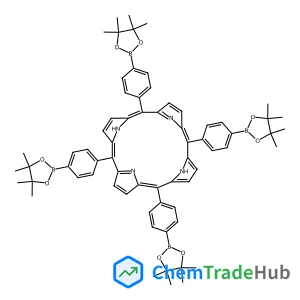
5,10,15,20-tetrakis(4-boronic acid pinacol ester phenyl) porphyrin
CAS番号:
1332748-00-1
分子式:
C68H74B4N4O8
おすすめサプライヤー





免責事項
このページに表示される学術雑誌情報は、参考および研究目的のみを目的としています。当社は雑誌出版社とは提携しておらず、投稿の取り扱いも行っておりません。出版に関するお問い合わせは、各雑誌出版社に直接ご連絡ください。
表示されている情報に誤りがある場合は、support@chemtradehub.com までご連絡ください。迅速に確認し、対応いたします。