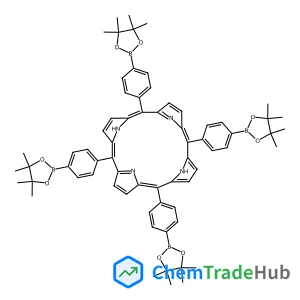
5,10,15,20-tetrakis(4-boronic acid pinacol ester phenyl) porphyrin
CAS番号:
1332748-00-1
分子式:
C68H74B4N4O8
Julia Kuligowski, David Pérez-Guaita, Ángel Sánchez-Illana, Zacarías León-González, Miguel de la Guardia, Eric F. Lock
Metabolic profiling is increasingly being used for understanding biological processes but there is no single analytical technique that provides a complete quantitative or qualitative profiling of the metabolome. Data fusion (i.e. joint analysis of data from multiple sources) has the potential to circumvent this issue facilitating knowledge discovery and reliable biomarker identification. Another field of application of data fusion is the simultaneous analysis of metabolomic changes through several biofluids or tissues. However, metabolomics typically deals with large datasets, with hundreds to thousands of variables and the identification of shared and individual factors or structures across multiple sources is challenging due to the high variable to sample ratios and differences in intensity and noise range. In this work we apply a recent method, Joint and Individual Variation Explained (JIVE), for the integrated unsupervised analysis of metabolomic profiles from multiple data sources. This method separates the shared patterns among data sources (i.e. the joint structure) from the individual structure of each data source that is unrelated to the joint structure. Two examples are described to show the applicability of JIVE for the simultaneous analysis of multi-source data using: (i) plasma samples subjected to different analytical techniques, sample treatment and measurement conditions; and (ii) plasma and urine samples subjected to liquid chromatography-mass spectrometry measured using two ionization conditions.

Russian Journal of General Chemistry

Journal of Saudi Chemical Society

Current Opinion in Colloid & Interface Science

Acta Materialia

Russian Journal of Coordination Chemistry

Crystallography Reports

Drug Discovery Today

Journal of Natural Medicines

Chemistry Education Research and Practice

Journal of Peptide Science
Szymon W. Przybylak, Floriana Tuna, Simon J. Teat, Richard E. P. Winpenny
DOI: 10.1039/B717277J
Shinji Matsumoto, Satoshi Yamaguchi, Atsuhiko Wada, Toshihiro Matsui, Masato Ikeda
DOI: 10.1039/B719004B
Yue-Ling Bai, Jun Tao, Rong-Bin Huang, Lan-Sun Zheng, Shao-Liang Zheng, Kazuyoshi Oshida, Yasuaki Einaga
DOI: 10.1039/B718456E
Chuan-Feng Chen, Zhi-Tang Huang
DOI: 10.1039/B800258D
Shik Chi Tsang, Stan Golunski, Paul Collier
DOI: 10.1039/B718956G
Yasuo Norikane, Ryuzi Katoh, Nobuyuki Tamaoki
DOI: 10.1039/B718813G
Stéphane Viel, Stefano Caldarelli
DOI: 10.1039/B802789G
Nicolas Bouquin, Vladimir L. Malinovskii, Robert Häner
DOI: 10.1039/B802193G
4-アミノフェノール酸ナトリウム水和物は、CAS番号206557-08-6の化合物で、4-アミノフェノールとナトリウムが結合した塩と水和物です。この化合物は、白...
この化合物は特定の合成プロセスに使用される可能性がありますが、代替品として、他の类似的な化合物、例えばMethyl 3-methyl-N-{[(2-methyl...
4-Boc-2-哌嗪甲酸は、薬品開発や合成化学分野で広く使用されており、その需要は継続的に推移しています。特に、新薬開発における合成化学分野での需要が高まってい...
4,4'-二羟甲基联苯のCAS番号は1667-12-5です。この化合物は白色の結晶粉末で、分子量は154.20です。水にわずかに溶けますが、アルコールや有機溶媒...
5-甲硫基戊腈は医薬品産業で使用される可能性があります。また、ポリマー合成の触媒として、センサー製造の一部として、半導体製造のプロセス改善に使用される可能性があ...
この化合物は、1-abieta-8,11,13-trien-19-イルと6'-メトキシシンコナナン-9-基を含有する窒素含有化合物から合成されます。一般的な合成...
6-ブロモベンジジミダゾール-2-カルビルデオキシドは、避光・乾燥した容器(密閉容器)で-20℃~4℃の低温で保存してください。高温や直射日光、湿気は避けてくだ...
621-65-8のCAS番号を持つBoc-N-甲基氨甲环酸は、化学式C7H13NO5を有する化合物です。この化合物は白色の結晶性粉末で、吸湿性があります。
乙基三氟硼酸钾は、トリフLUオール酸カリウムとエチルブロミドを反応させて合成されます。この反応は高い選択性と収率を持ち、触媒を用いることで効率的に進行します。
2-フロウロ-5-クロロ-4-アミノフェノールは、直射日光を避けて冷却された暗所で保存し、密閉容器に保管してください。温度は常温か低温が適しています。

Analyst publishes analytical and bioanalytical research that reports premier fundamental discoveries and inventions, and the applications of those discoveries, unconfined by traditional discipline barriers.
![(4aR,5S,6R,8aS)-5-[2-(3-Furyl)ethyl]-8a-(hydroxymethyl)-5,6-dimethyl-3,4,4a,5,6,7,8,8a-octahydro-1-naphthalenecarboxylic acid structure](https://static.chemtradehub.com/structs/184/18411-75-1-d4cd.webp "(4aR,5S,6R,8aS)-5-[2-(3-Furyl)ethyl]-8a-(hydroxymethyl)-5,6-dimethyl-3,4,4a,5,6,7,8,8a-octahydro-1-naphthalenecarboxylic acid structure")