


Sensitive, quantitative, and high-throughput detection of angiogenic markers using shape-coded hydrogel microparticles
文献情報
出版日
2015-05-15
DOI
10.1039/C5AN00358J
インパクトファクター
4.616
著者
Mohammad Ali Al-Ameen, Ji Li, David G. Beer, Gargi Ghosh
原文を見る
要旨
Elevated serum concentrations of angiogenic markers including vascular endothelial growth factor (VEGF), fibroblast growth factor (FGF), and platelet-derived growth factor (PDGF) have been correlated with various clinical disorders including cancer, cardiovascular diseases, diabetes mellitus, and liver fibrosis. In addition, the correlation between the serum concentrations of these factors, clinical diagnosis, prognosis, and response to therapeutic agents is significant. Thereby suggesting high-throughput detection of serum levels of angiogenic markers has important implications in early detection of different clinical disorders as well as for subsequent therapy monitoring. Here, we demonstrate the feasibility of utilization of shape-coded hydrogel microparticle based suspension arrays for quantitative and reproducible measurement of VEGF, FGF, and PDGF in single and multiplexed assays. Bio-inert PEG hydrogel attenuated the background signal thereby improving the sensitivity of the detection method as well as eliminating the need for blocking the proteins. In the singleplexed assay, the detection limits of 1.7 pg ml−1, 1.4 pg ml−1, and 1.5 pg ml−1 for VEGF, FGF, and PDGF respectively indicated that the sensitivity of the developed method exceeds that of the conventional technologies. We also demonstrated that in the multiplexed assays, recovery of the proteins was within 20% of the expected values. The practical applicability of the hydrogel microparticle based detection system was established by demonstrating the ability of the system to quantify the production of VEGF, FGF, and PDGF by breast cancer cells (MDA-MB-231).
おすすめジャーナル

Journal of Saudi Chemical Society

Journal of Peptide Science

Russian Journal of Bioorganic Chemistry

New Journal of Chemistry

Nature Medicine

Current Opinion in Solid State & Materials Science

Russian Journal of General Chemistry

Chemistry Education Research and Practice

Acta Materialia

Russian Journal of Organic Chemistry
関連文献
The effects of surface topography of nanostructure arrays on cell adhesion
Jing Zhou, Xiaowei Zhang, Jizheng Sun, Zechun Dang, Jinqi Li, Xinlei Li, Tongsheng Chen
2018-08-16
Paper
DOI: 10.1039/C8CP03538E
The dimensional and hydrogenating effect on the electronic properties of ZnSe nanomaterials: a computational investigation
Xiaodong Lv, Fengyu Li, Jian Gong, Zhongfang Chen
2018-09-04
Paper
DOI: 10.1039/C8CP04472D
Distribution of zwitter-ionic tryptophan between the micelles of 1-dodecyl-3-methyl imidazolium and aqueous medium from molecular dynamic simulation
Elena A. Belyaeva, Aleksandr A. Vanin, Alexey I. Victorov
2018-08-29
Paper
DOI: 10.1039/C8CP02488J
Orientation selection in high-field RIDME and PELDOR experiments involving low-spin CoII ions
Claire L. Motion, Michael Bühl, Graham M. Smith
2018-01-05
Communication
DOI: 10.1039/C7CP07248A
Nonlinear optical responses of self-assembled monolayers functionalized with indolino–oxazolidine photoswitches
Claire Tonnelé, Jean Deviers, Luca Muccioli, Benoît Champagne, Frédéric Castet
2018-07-31
Paper
DOI: 10.1039/C8CP02991A
Probing molecular forces in multi-component physiological membranes
2017-11-27
Paper
DOI: 10.1039/C7CP05981G
Improved model for the refractive index: application to potential components of ambient aerosol
Rémi Bouteloup, Didier Mathieu
2018-08-07
Paper
DOI: 10.1039/C8CP02701C
Correction: Model of protocell compartments – dodecyl hydrogen sulfate vesicles
Bin Liu, Meihua Gao, Haiping Li, Jianqiang Liu, Shiling Yuan, Na Du
2018-01-23
Correction
DOI: 10.1039/C8CP90011F
Photodissociation dynamics of bromoiodomethane from the first and second absorption bands. A combined velocity map and slice imaging study
David V. Chicharro, Eduardo Navarro, Luis Rubio-Lago, Luis Bañares
2018-01-03
Paper
DOI: 10.1039/C7CP07077B
こちらもおすすめ
化合物よくある質問
4-アミノフェノール酸ナトリウム水和物とは何ですか?
4-アミノフェノール酸ナトリウム水和物は、CAS番号206557-08-6の化合物で、4-アミノフェノールとナトリウムが結合した塩と水和物です。この化合物は、白...
206557-08-64-Aminobenzoic acid ...
化合物よくある質問
Methyl 3-methyl-N-{[(2-methyl-2-propanyl)oxy]carbonyl}-L-histidinateの代替品はありますか?
この化合物は特定の合成プロセスに使用される可能性がありますが、代替品として、他の类似的な化合物、例えばMethyl 3-methyl-N-{[(2-methyl...
72212-51-2Methyl 3-methyl-N-{[...
化合物よくある質問
4-Boc-2-哌嗪甲酸の市場動向や研究トレンドはどうですか?
4-Boc-2-哌嗪甲酸は、薬品開発や合成化学分野で広く使用されており、その需要は継続的に推移しています。特に、新薬開発における合成化学分野での需要が高まってい...
192330-11-3(2R)-4-[(tert-butoxy...
化合物よくある質問
4,4'-二羟甲基联苯の物理化学的性質は何ですか?
4,4'-二羟甲基联苯のCAS番号は1667-12-5です。この化合物は白色の結晶粉末で、分子量は154.20です。水にわずかに溶けますが、アルコールや有機溶媒...
1667-12-54,4'-Biphenyldiyldim...
化合物よくある質問
5-甲硫基戊腈はどの業界で使用されていますか?
5-甲硫基戊腈は医薬品産業で使用される可能性があります。また、ポリマー合成の触媒として、センサー製造の一部として、半導体製造のプロセス改善に使用される可能性があ...
59121-25-45-(Methylsulfanyl)pe...
化合物よくある質問
CAS番号1311961-50-8の化合物はどのように合成されますか?
この化合物は、1-abieta-8,11,13-trien-19-イルと6'-メトキシシンコナナン-9-基を含有する窒素含有化合物から合成されます。一般的な合成...
1311961-50-81-Abieta-8,11,13-tri...
化合物よくある質問
6-ブロモベンジジミダゾール-2-カルビルデオキシドはどのように保存すればよいですか?
6-ブロモベンジジミダゾール-2-カルビルデオキシドは、避光・乾燥した容器(密閉容器)で-20℃~4℃の低温で保存してください。高温や直射日光、湿気は避けてくだ...
885280-26-25-Bromo-1H-benzimida...
化合物よくある質問
Boc-N-甲基氨甲环酸とは何ですか?
621-65-8のCAS番号を持つBoc-N-甲基氨甲环酸は、化学式C7H13NO5を有する化合物です。この化合物は白色の結晶性粉末で、吸湿性があります。
621-65-83-Hydroxy-1,2-propan...
化合物よくある質問
乙基三氟硼酸钾はどのように合成されますか?
乙基三氟硼酸钾は、トリフLUオール酸カリウムとエチルブロミドを反応させて合成されます。この反応は高い選択性と収率を持ち、触媒を用いることで効率的に進行します。
882871-21-8Potassium ethyltrifl...
化合物よくある質問
2-フロウロ-5-クロロ-4-アミノフェノールはどのように保存すればよいですか?
2-フロウロ-5-クロロ-4-アミノフェノールは、直射日光を避けて冷却された暗所で保存し、密閉容器に保管してください。温度は常温か低温が適しています。
847872-10-04-Amino-5-chloro-2-f...
掲載誌
Analyst

CiteScore:
7.8
自己引用率:
5.6%
年間論文数:
653
Analyst publishes analytical and bioanalytical research that reports premier fundamental discoveries and inventions, and the applications of those discoveries, unconfined by traditional discipline barriers.
おすすめ化合物
![6,7-Dihydro-5H-pyrrolo[1,2-a]imidazole-6-carboxylic acid structure](https://static.chemtradehub.com/structs/136/1369160-12-2-6524.webp "6,7-Dihydro-5H-pyrrolo[1,2-a]imidazole-6-carboxylic acid structure")
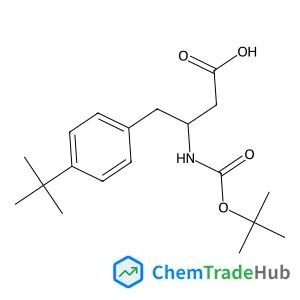
(S)-3-((tert-Butoxycarbonyl)amino)-4-(4-(tert-butyl)phenyl)butanoic acid
CAS番号:
403661-85-8
分子式:
C19H29NO4
おすすめサプライヤー




免責事項
このページに表示される学術雑誌情報は、参考および研究目的のみを目的としています。当社は雑誌出版社とは提携しておらず、投稿の取り扱いも行っておりません。出版に関するお問い合わせは、各雑誌出版社に直接ご連絡ください。
表示されている情報に誤りがある場合は、support@chemtradehub.com までご連絡ください。迅速に確認し、対応いたします。