


Ultra-sensitive detection of explosives in solution and film as well as the development of thicker film effectiveness by tetraphenylethene moiety in AIE active fluorescent conjugated polymer
文献情報
出版日
2014-06-11
DOI
10.1039/C4PY00673A
インパクトファクター
5.582
著者
Khama Rani Ghosh, Sukanta Kumar Saha
原文を見る
要旨
A fluorescence sensory polymer (P1) consisting of pentiptycene and tetraphenylethene (TPE) units linked by acetylene was synthesized for direct detection of explosives in solution and air. At the same time, the effectiveness of thicker film in the presence of the TPE moiety for the detection of explosives was investigated. Fluorescence turn-off detection of picric acid (PA) was carried out in H2O–THF mixture containing 90% water, where the TPE units of the polymer are in a highly emissive aggregation state. Polymer P1 exhibits a fluorescence quenching response of 24% with addition of 4.36 × 10⁻⁸ M PA and 98% with the PA concentration at 4.7 × 10⁻⁶ M. For a thinner film (4 nm) of P1 after exposure to dinitrotoluene for 10 s, the fluorescence intensity dropped 48% and it continued to drop 97% after 300 s, the corresponding values being 29% and 72% for thicker film (75 nm), respectively. These results indicate that P1 is a promising material for direct detection of nitro explosives in air and solution at ppb levels, and the TPE moiety inside the polymer improves the sensitivity and effectiveness of thicker films.
おすすめジャーナル

Current Opinion in Solid State & Materials Science

Journal of Saudi Chemical Society

Organic Process Research & Development

Journal of Peptide Science

Current Opinion in Colloid & Interface Science

Acta Materialia

Crystallography Reports

Saudi Pharmaceutical Journal

Chemistry Education Research and Practice

Russian Journal of Coordination Chemistry
関連文献
Formation of resonances and anionic fragments upon electron attachment to benzaldehyde
E. Arthur-Baidoo, J. Pereira-da-Silva, M. Ryszka, I. Carmichael, L. M. Cornetta, M. T. do N. Varella, F. Ferreira da Silva, S. Denifl
2020-03-16
Paper
DOI: 10.1039/D0CP00029A
Microdynamic changes of moisture-induced crystallization of amorphous calcium carbonate revealed via in situ FTIR spectroscopy
Meng Cheng, Shengtong Sun, Peiyi Wu
2019-09-06
Paper
DOI: 10.1039/C9CP04440J
Thermal activation of methane by MgO+: temperature dependent kinetics, reactive molecular dynamics simulations and statistical modeling
Brendan C. Sweeny, Hanqing Pan, Asmaa Kassem, Jordan C. Sawyer, Shaun G. Ard, Nicholas S. Shuman, Albert A. Viggiano, Sebastian Brickel, Oliver T. Unke, Meenu Upadhyay, Markus Meuwly
2020-03-23
Paper
DOI: 10.1039/D0CP00668H
The influence of a type III antifreeze protein and its mutants on methane hydrate adsorption–inhibition: a molecular dynamics simulation study
Mitra Maddah, Mina Maddah, Kiana Peyvandi
2019-08-31
Paper
DOI: 10.1039/C9CP03833G
The co-reactant role during plasma enhanced atomic layer deposition of palladium
Ji-Yu Feng, Matthias M. Minjauw, Ranjith K. Ramachandran, Michiel Van Daele, Hilde Poelman, Timo Sajavaara, Jolien Dendooven, Christophe Detavernier
2020-04-07
Paper
DOI: 10.1039/D0CP00786B
Static and dynamic scavenging of ammoniated electrons by nitromethane
Nicolás Rivas, Germán Sciaini, Ernesto Marceca
2019-09-16
Paper
DOI: 10.1039/C9CP03342D
HERFD-XANES probes of electronic structures of ironII/III carbene complexes
Om Prakash, Hao Fan, Lisa H. M. de Groot, Valtýr Freyr Hlynsson, Simon Kaufhold, Olga Gordivska, Nicolás Velásquez, Pavel Chabera, Pieter Glatzel, Kenneth Wärnmark, Petter Persson, Jens Uhlig
2020-04-16
Paper
DOI: 10.1039/C9CP06309A
The mechanism of thiophene oxidation on metal-free two-dimensional hexagonal boron nitride
Naixia Lv, Linghao Sun, Linlin Chen, Yujun Li, Jinrui Zhang, Peiwen Wu, Hongping Li, Wenshuai Zhu, Huaming Li
2019-09-18
Paper
DOI: 10.1039/C9CP03758F
Hysteresis in graphene nanoribbon field-effect devices
Akimitsu Narita, Hai I. Wang
2020-02-18
Paper
DOI: 10.1039/D0CP00298D
Thermal decomposition of mixed calcium oxalate hydrates – kinetic deconvolution of complex heterogeneous processes
Roman Svoboda, Zuzana Olmrová Zmrhalová, Dušan Galusek, Daniela Brandová, Jozef Chovanec
2020-03-23
Paper
DOI: 10.1039/C9CP06867H
こちらもおすすめ
28770-01-62-(2-Isopropyl-1,3-o...
化合物よくある質問
「邻羟基阿托伐他汀内酯标准品」に適用される法規ガイドelinesは何ですか?
CAS番号163217-74-1の「邻羟基阿托伐他汀内酯标准品」は、GHS分類では危険物に分類されず、主にREACH規則とFDA/EPAの管理対象となります。R...
163217-74-1ortho-Hydroxy Atorva...
化合物よくある質問
メチル(3R)-3-アミノ-2,3-ジヒドロ-1-ベンゾファンラニン-5-カルボイル酸塩塩酸塩の主な用途は何ですか?
メチル(3R)-3-アミノ-2,3-ジヒドロ-1-ベンゾファンラニン-5-カルボイル酸塩塩酸塩は、医薬品や合成化学の研究に広く用いられます。また、特定の薬物の前...
2241594-15-8Methyl (3R)-3-amino-...
化合物よくある質問
トランス-4-メチルピロリジン-3-オール塩酸塩はどのように合成されますか?
トランス-4-メチルピロリジン-3-オール塩酸塩は、4-メチルピロリジンの塩酸塩化によって合成されます。一般的な合成方法では、4-メチルピロリジンを塩酸に加えて...
265108-42-7trans-4-Methylpyrrol...
化合物よくある質問
硫雜環丁烷-1,1-二氧化物は安全ですか?
硫雜環丁烷-1,1-二氧化物は安全ではありません。毒性は報告されていませんが、高温下で分解し、可燃性があるため、高圧ガスは注意が必要です。密閉した容器で保管し、...
5687-92-3Thietane 1,1-dioxide
6054-10-02H, 8H-Benzo[1,2-b
化合物よくある質問
9-ヒドロキシエリプチシネ塩酸塩はどのように合成されますか?
9-ヒドロキシエリプチシネ塩酸塩は、エリプチシネから塩酸を添加することで合成されます。選択性は高いですが、収率は約70%です。
52238-35-49-Hydroxyellipticine...
化合物よくある質問
5-塩素-2-(メチルアミノ)フェニル-(2-塩素フェニル)メタン酮の物理化学的性質は何ですか?
5-塩素-2-(メチルアミノ)フェニル-(2-塩素フェニル)メタン酮のCAS番号は5621-86-3です。この化合物は白色の結晶性粉末で、分子量は415.03で...
5621-86-3[5-Chloro-2-(methyla...
化合物よくある質問
1-[2-(4-甲氧基-苯氧基)-乙基]-哌嗪はどのように保存すればよいですか?
1-[2-(4-甲氧基-苯氧基)-乙基]-哌嗪は、直射日光を避けて暗所に、室温(15-25℃)で保管し、密閉容器に入れることで安定性を保つことができます。
117132-44-21-[2-(4-Methoxy-phen...
化合物よくある質問
2-[3-(4-甲氧基フェニル)プロピル]-4,4,5,5-四メチル-1,3,2-ドイボロロールアンの主な用途は何ですか?
2-[3-(4-甲氧基フェニル)プロピル]-4,4,5,5-四メチル-1,3,2-ドイボロロールアンは、医薬品の合成、有機合成化学、および新材料の研究で使用され...
1073371-72-82-[3-(4-Methoxypheny...
掲載誌
Polymer Chemistry

CiteScore:
8.6
自己引用率:
7.3%
年間論文数:
457
Polymer Chemistry welcomes submissions in all areas of polymer science that have a strong focus on macromolecular chemistry. Manuscripts may cover a broad range of fields, yet no direct application focus is required.
おすすめ化合物
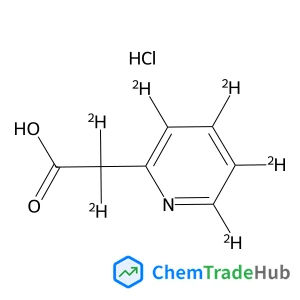
2,2-dideuterio-2-(3,4,5,6-tetradeuterio-2-pyridyl)acetic acid;hydrochloride
CAS番号:
1329799-67-8
分子式:
C7H2ClD6NO2
おすすめサプライヤー




免責事項
このページに表示される学術雑誌情報は、参考および研究目的のみを目的としています。当社は雑誌出版社とは提携しておらず、投稿の取り扱いも行っておりません。出版に関するお問い合わせは、各雑誌出版社に直接ご連絡ください。
表示されている情報に誤りがある場合は、support@chemtradehub.com までご連絡ください。迅速に確認し、対応いたします。