












Thermo-responsive gold/poly(vinyl alcohol)-b-poly(N-vinylcaprolactam) core–corona nanoparticles as a drug delivery system
文献情報
出版日
2014-05-09
DOI
10.1039/C4PY00352G
インパクトファクター
5.582
著者
Christophe Detrembleur, Marie Hurtgen, Antoine Debuigne, Marie-Claire De Pauw-Gillet, Stéphane Mornet, Etienne Duguet, Christine Jérôme
原文を見る
要旨
Core–corona gold/poly(vinyl alcohol)-b-poly(N-vinylcaprolactam) nanoparticles (gold@PVOH-b-PNVCL NPs) were fabricated via an in situ method, where a gold salt was reduced within the macromolecular aqueous solution. Arrangement of macromolecular chains on the surface of gold cores was studied by transmission electron microscopy (TEM), X-ray photoelectron spectroscopy and infrared spectroscopy. The responsiveness to temperature and the preserved colloidal stability of the gold@PVOH-b-PNVCL NPs above the lower critical solution temperature (LCST) were confirmed by dynamic light scattering and turbidity measurements. The drug loading capacity (DLC of ca. 1.3–2.8 wt%) of the gold@PVOH-b-PNVCL NPs as a drug delivery system (DDS) was tested with Nadolol®, a hydrophilic drug, and the release behaviours were studied at several temperatures. PVOH-b-PNVCL copolymers with an LCST of a few degrees above the biological temperature (37 °C), for example, PVOH180-b-PNVCL110 (LCST of 41 °C), are preferential, due to the slower release at 37 °C, but a faster release at temperatures that are a few degrees higher. The cytocompatibility of the gold@PVOH-b-PNVCL NPs against mouse fibroblastic L929 cells was evaluated via the MTS assay. Cellular uptake within MEL-5 human melanoma cells was studied by confocal laser scanning microscopy, fluorescence-activated cell sorting and TEM techniques and it showed that gold@PVOH-b-PNVCL NPs preferably accumulated within the cellular cytoplasm, with an incubation concentration and period-dependent uptake process. All these results corroborated a general utility of these thermo-responsive gold@PVOH-b-PNVCL NPs for drug delivery and controlled drug release.
関連文献
Carbon sp chains in diamond nanocavities
Francesco Delodovici, Daniel S. Choi, Mohamed Al Fahim, Larry A. Burchfield, Nicola Manini
2019-09-18
Paper
DOI: 10.1039/C9CP03978C
Effects of different surface functionalization on the electronic properties and contact types of graphene/functionalized-GeC van der Waals heterostructures
Tan Phat Dao, M. Idrees, Huynh V. Phuc, Nguyen N. Hieu, Nguyen T. T. Binh, Hoi B. Dinh, B. Amin, Chuong V. Nguyen
2020-03-13
Paper
DOI: 10.1039/C9CP07009E
Embedding of atoms into the nanopore sites of the C6N6 and C6N8 porous carbon nitride monolayers with tunable electronic properties
Catherine Stampfl, Berna Akgenc, Mitra Ghergherehchi, Ch. V. Nguyen
2020-02-20
Paper
DOI: 10.1039/D0CP00093K
Correction: Long-range corrected density functional through the density matrix expansion based semilocal exchange hole
Bikash Patra, Subrata Jana, Prasanjit Samal
2019-09-27
Correction
DOI: 10.1039/C9CP90239B
Enhanced carrier mobility and tunable electronic properties in α-tellurene monolayer via an α-tellurene and h-BN heterostructure
Xingtao Jia, Yujin Liu, Weiyang Yu, Baoji Wang, Xuefeng Yang, Qin Wang
2020-02-26
Paper
DOI: 10.1039/D0CP00269K
Understanding the properties of dithienylethenes functionalized for supramolecular self-assembly: a molecular modeling study
Laura Le Bras, Roxanne Berthin, Ismaïl Hamdi, Maroua Louati, Stéphane Aloïse, Michinori Takeshita
2020-03-09
Paper
DOI: 10.1039/C9CP06590C
Linking structure to performance of Li1.2Mn0.54Ni0.13Co0.13O2 (Li and Mn rich NMC) cathode materials synthesized by different methods
N. Leifer, T. Penki, R. Nanda, J. Grinblat, S. Luski, D. Aurbach, G. Goobes
2020-04-02
Paper
DOI: 10.1039/D0CP00400F
Tailoring the structural and electronic properties of an SnSe2/MoS2 van der Waals heterostructure with an electric field and the insertion of a graphene sheet
Nguyen V. Hieu, Le T. P. Thao, Nguyen N. Hieu, Huynh V. Phuc, H. D. Bui, M. Idrees, B. Amin, Le M. Duc, Chuong V. Nguyen
2019-09-24
Paper
DOI: 10.1039/C9CP04689E
The physical stage of radiolysis of solvated DNA by high-energy-transfer particles: insights from new first principles simulations
Aurelio Alvarez-Ibarra, Aurélien de la Lande
2020-03-12
Paper
DOI: 10.1039/D0CP00165A
β12-Borophene becomes a semiconductor and semimetal via a perpendicular electric field and dilute charged impurity
T. C. Phong
2019-09-20
Paper
DOI: 10.1039/C9CP04719K
こちらもおすすめ
28770-01-62-(2-Isopropyl-1,3-o...
化合物よくある質問
「邻羟基阿托伐他汀内酯标准品」に適用される法規ガイドelinesは何ですか?
CAS番号163217-74-1の「邻羟基阿托伐他汀内酯标准品」は、GHS分類では危険物に分類されず、主にREACH規則とFDA/EPAの管理対象となります。R...
163217-74-1ortho-Hydroxy Atorva...
化合物よくある質問
メチル(3R)-3-アミノ-2,3-ジヒドロ-1-ベンゾファンラニン-5-カルボイル酸塩塩酸塩の主な用途は何ですか?
メチル(3R)-3-アミノ-2,3-ジヒドロ-1-ベンゾファンラニン-5-カルボイル酸塩塩酸塩は、医薬品や合成化学の研究に広く用いられます。また、特定の薬物の前...
2241594-15-8Methyl (3R)-3-amino-...
化合物よくある質問
トランス-4-メチルピロリジン-3-オール塩酸塩はどのように合成されますか?
トランス-4-メチルピロリジン-3-オール塩酸塩は、4-メチルピロリジンの塩酸塩化によって合成されます。一般的な合成方法では、4-メチルピロリジンを塩酸に加えて...
265108-42-7trans-4-Methylpyrrol...
化合物よくある質問
硫雜環丁烷-1,1-二氧化物は安全ですか?
硫雜環丁烷-1,1-二氧化物は安全ではありません。毒性は報告されていませんが、高温下で分解し、可燃性があるため、高圧ガスは注意が必要です。密閉した容器で保管し、...
5687-92-3Thietane 1,1-dioxide
6054-10-02H, 8H-Benzo[1,2-b
化合物よくある質問
9-ヒドロキシエリプチシネ塩酸塩はどのように合成されますか?
9-ヒドロキシエリプチシネ塩酸塩は、エリプチシネから塩酸を添加することで合成されます。選択性は高いですが、収率は約70%です。
52238-35-49-Hydroxyellipticine...
化合物よくある質問
5-塩素-2-(メチルアミノ)フェニル-(2-塩素フェニル)メタン酮の物理化学的性質は何ですか?
5-塩素-2-(メチルアミノ)フェニル-(2-塩素フェニル)メタン酮のCAS番号は5621-86-3です。この化合物は白色の結晶性粉末で、分子量は415.03で...
5621-86-3[5-Chloro-2-(methyla...
化合物よくある質問
1-[2-(4-甲氧基-苯氧基)-乙基]-哌嗪はどのように保存すればよいですか?
1-[2-(4-甲氧基-苯氧基)-乙基]-哌嗪は、直射日光を避けて暗所に、室温(15-25℃)で保管し、密閉容器に入れることで安定性を保つことができます。
117132-44-21-[2-(4-Methoxy-phen...
化合物よくある質問
2-[3-(4-甲氧基フェニル)プロピル]-4,4,5,5-四メチル-1,3,2-ドイボロロールアンの主な用途は何ですか?
2-[3-(4-甲氧基フェニル)プロピル]-4,4,5,5-四メチル-1,3,2-ドイボロロールアンは、医薬品の合成、有機合成化学、および新材料の研究で使用され...
1073371-72-82-[3-(4-Methoxypheny...
掲載誌
Polymer Chemistry

CiteScore:
8.6
自己引用率:
7.3%
年間論文数:
457
Polymer Chemistry welcomes submissions in all areas of polymer science that have a strong focus on macromolecular chemistry. Manuscripts may cover a broad range of fields, yet no direct application focus is required.
おすすめ化合物
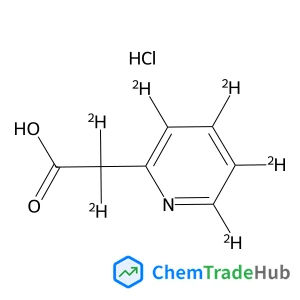
2,2-dideuterio-2-(3,4,5,6-tetradeuterio-2-pyridyl)acetic acid;hydrochloride
CAS番号:
1329799-67-8
分子式:
C7H2ClD6NO2
おすすめサプライヤー





免責事項
このページに表示される学術雑誌情報は、参考および研究目的のみを目的としています。当社は雑誌出版社とは提携しておらず、投稿の取り扱いも行っておりません。出版に関するお問い合わせは、各雑誌出版社に直接ご連絡ください。
表示されている情報に誤りがある場合は、support@chemtradehub.com までご連絡ください。迅速に確認し、対応いたします。