












Solution-based nanosensors for in-field detection with the naked eye
文献情報
出版日
2015-03-16
DOI
10.1039/C4AN02297A
インパクトファクター
4.616
著者
S. Paterson, R. de la Rica
原文を見る
要旨
Nanomaterials are revolutionising analytical applications with low-cost tests that enable detecting a target molecule in a few steps and with the naked eye. With this approach, non-experts can perform analyses on-site and without utilising electronic readers. This is advantageous in point-of-care diagnostics, in-field measurements and analyses performed in resource-constrained settings. Here we review the main strategies adopted for detecting analytes with the naked eye and at the point of need using plasmonic nanosensors, catalytic nanoparticles and fluorescent nanomaterials. Examples of the detection of ions, glucose, small molecules, peptides and proteins with the nanosensors are explained in detail.
関連文献
HSO2 isomers in rare-gas solids
Esa Isoniemi, Leonid Khriachtchev, Jan Lundell, Markku Räsänen
2002-03-21
Paper
DOI: 10.1039/B110109A
Pore size engineering of mesoporous silicon nitride materials
Stefan Kaskel, Klaus Schlichte, Bodo Zibrowius
2002-03-20
Paper
DOI: 10.1039/B109708N
Towards the determination of partition coefficients of cosurfactants at surfactant bilayer interfaces by muon spin resonance spectroscopy
Robert Scheuermann, Ian M. Tucker, Andrew M. Creeth, Herbert Dilger, Bettina Beck, Emil Roduner
2002-03-25
Communication
DOI: 10.1039/B201531P
Self-motion of a camphoric acid boat sensitive to the chemical environment
Yuko Hayashima, Masaharu Nagayama, Yukie Doi, Satoshi Nakata, Maya Kimura, Masayasu Iida
2002-03-15
Paper
DOI: 10.1039/B108686C
Rotational conformers of m-methoxybenzyl radical in a supersonic jet
Kosaku Sakeda, Tadashi Suzuki, Yoshihisa Matsushita, Teijiro Ichimura
2002-04-18
Paper
DOI: 10.1039/B111406A
Statistical theory of cluster cooling in rare gas Part II. The PEMET model
Sture Nordholm, Hongrei Li
2002-04-09
Paper
DOI: 10.1039/B108996J
Electrical conductivity of reverse micelles in supercritical carbon dioxide
Christian Blattner, Jürgen Bittner, Georg Schmeer, Werner Kunz
2002-04-16
Paper
DOI: 10.1039/B109085B
Rate constants for the reactions of chlorine atoms with a series of unsaturated aldehydes and ketones at 298 K: structure and reactivity
Weihong Wang, Michael J. Ezell, Alisa A. Ezell, Gennady Soskin, Barbara J. Finlayson-Pitts
2002-04-18
Paper
DOI: 10.1039/B111557J
Ion exchange in the synthetic gismondine, zeolite MAP
Susan Allen, Stuart Carr, Andrew Chapple, Alan Dyer, Brigid Heywood
2002-05-02
Paper
DOI: 10.1039/B111490P
Propagating fronts in periodic precipitation systems with redissolution
2002-03-14
Invited Article
DOI: 10.1039/B109278M
こちらもおすすめ
化合物よくある質問
4-アミノフェノール酸ナトリウム水和物とは何ですか?
4-アミノフェノール酸ナトリウム水和物は、CAS番号206557-08-6の化合物で、4-アミノフェノールとナトリウムが結合した塩と水和物です。この化合物は、白...
206557-08-64-Aminobenzoic acid ...
化合物よくある質問
Methyl 3-methyl-N-{[(2-methyl-2-propanyl)oxy]carbonyl}-L-histidinateの代替品はありますか?
この化合物は特定の合成プロセスに使用される可能性がありますが、代替品として、他の类似的な化合物、例えばMethyl 3-methyl-N-{[(2-methyl...
72212-51-2Methyl 3-methyl-N-{[...
化合物よくある質問
4-Boc-2-哌嗪甲酸の市場動向や研究トレンドはどうですか?
4-Boc-2-哌嗪甲酸は、薬品開発や合成化学分野で広く使用されており、その需要は継続的に推移しています。特に、新薬開発における合成化学分野での需要が高まってい...
192330-11-3(2R)-4-[(tert-butoxy...
化合物よくある質問
4,4'-二羟甲基联苯の物理化学的性質は何ですか?
4,4'-二羟甲基联苯のCAS番号は1667-12-5です。この化合物は白色の結晶粉末で、分子量は154.20です。水にわずかに溶けますが、アルコールや有機溶媒...
1667-12-54,4'-Biphenyldiyldim...
化合物よくある質問
5-甲硫基戊腈はどの業界で使用されていますか?
5-甲硫基戊腈は医薬品産業で使用される可能性があります。また、ポリマー合成の触媒として、センサー製造の一部として、半導体製造のプロセス改善に使用される可能性があ...
59121-25-45-(Methylsulfanyl)pe...
化合物よくある質問
CAS番号1311961-50-8の化合物はどのように合成されますか?
この化合物は、1-abieta-8,11,13-trien-19-イルと6'-メトキシシンコナナン-9-基を含有する窒素含有化合物から合成されます。一般的な合成...
1311961-50-81-Abieta-8,11,13-tri...
化合物よくある質問
6-ブロモベンジジミダゾール-2-カルビルデオキシドはどのように保存すればよいですか?
6-ブロモベンジジミダゾール-2-カルビルデオキシドは、避光・乾燥した容器(密閉容器)で-20℃~4℃の低温で保存してください。高温や直射日光、湿気は避けてくだ...
885280-26-25-Bromo-1H-benzimida...
化合物よくある質問
Boc-N-甲基氨甲环酸とは何ですか?
621-65-8のCAS番号を持つBoc-N-甲基氨甲环酸は、化学式C7H13NO5を有する化合物です。この化合物は白色の結晶性粉末で、吸湿性があります。
621-65-83-Hydroxy-1,2-propan...
化合物よくある質問
乙基三氟硼酸钾はどのように合成されますか?
乙基三氟硼酸钾は、トリフLUオール酸カリウムとエチルブロミドを反応させて合成されます。この反応は高い選択性と収率を持ち、触媒を用いることで効率的に進行します。
882871-21-8Potassium ethyltrifl...
化合物よくある質問
2-フロウロ-5-クロロ-4-アミノフェノールはどのように保存すればよいですか?
2-フロウロ-5-クロロ-4-アミノフェノールは、直射日光を避けて冷却された暗所で保存し、密閉容器に保管してください。温度は常温か低温が適しています。
847872-10-04-Amino-5-chloro-2-f...
掲載誌
Analyst

CiteScore:
7.8
自己引用率:
5.6%
年間論文数:
653
Analyst publishes analytical and bioanalytical research that reports premier fundamental discoveries and inventions, and the applications of those discoveries, unconfined by traditional discipline barriers.
おすすめ化合物
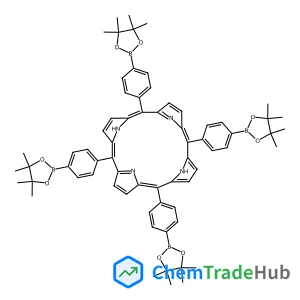
5,10,15,20-tetrakis(4-boronic acid pinacol ester phenyl) porphyrin
CAS番号:
1332748-00-1
分子式:
C68H74B4N4O8
![Imidazo[1,2-c]pyrimidine structure](https://static.chemtradehub.com/structs/274/274-78-2-8b4c.webp "Imidazo[1,2-c]pyrimidine structure")
![6,7-Dihydro-5H-pyrrolo[1,2-a]imidazole-6-carboxylic acid structure](https://static.chemtradehub.com/structs/136/1369160-12-2-6524.webp "6,7-Dihydro-5H-pyrrolo[1,2-a]imidazole-6-carboxylic acid structure")
おすすめサプライヤー






免責事項
このページに表示される学術雑誌情報は、参考および研究目的のみを目的としています。当社は雑誌出版社とは提携しておらず、投稿の取り扱いも行っておりません。出版に関するお問い合わせは、各雑誌出版社に直接ご連絡ください。
表示されている情報に誤りがある場合は、support@chemtradehub.com までご連絡ください。迅速に確認し、対応いたします。