












Tandem differential mobility spectrometry with ion dissociation in air at ambient pressure and temperature
文献情報
出版日
2015-03-13
DOI
10.1039/C4AN02159B
インパクトファクター
4.616
著者
M. R. Menlyadiev, A. Tarassov, A. M. Kielnecker, G. A. Eiceman
原文を見る
要旨
Proton-bound dimers were dissociated to protonated monomers in air at ambient pressure and temperature using electric fields of ultrahigh Field Asymmetric Ion Mobility Spectrometry (ultraFAIMS) with the onset of dissociation for ethyl acetate as 96 Td and for dimethyl methyl phosphonate as 170 Td. Ions then were measured by differential mobility spectrometry (DMS). Fragment ions were formed with propyl acetate at electric fields of 90 Td or greater. The dissociation in ultraFAIMS of ions, with compensation fields near zero, to form smaller ions with new compensation fields, provided a method to improve peak capacity in DMS without gas modifiers. These findings also lay the foundation for a triple stage DMS with a centre stage for ion dissociation or fragmentation.
おすすめジャーナル
関連文献
Unveiling excited state energy transfer and charge transfer in a host/guest coordination cage
Yang Yang, Song-Qiu Yang, Ke-Li Han
2017-12-06
Paper
DOI: 10.1039/C7CP06577A
The effects of surface topography of nanostructure arrays on cell adhesion
Jing Zhou, Xiaowei Zhang, Jizheng Sun, Zechun Dang, Jinqi Li, Xinlei Li, Tongsheng Chen
2018-08-16
Paper
DOI: 10.1039/C8CP03538E
Photoexcited charge carrier dynamics of interconnected TiO2 nanoparticles: evidence of enhancement of charge separation at anatase–rutile particle interfaces
Daiki Shingai, Yusuke Ide, Woon Yong Sohn
2018-01-03
Paper
DOI: 10.1039/C7CP07563D
Geometric and electronic structure of multilayered graphene: synergy of the nondirective ripples and the number of layers
Ting Ting Cui, Jian Chen Li, Wang Gao, Qing Jiang
2017-12-18
Paper
DOI: 10.1039/C7CP06446B
Influence of polaron doping and concentration dependent FRET on luminescence of PAni–PMMA blends for application in PLEDs
Dhritiman Banerjee, Asit Kumar Kar
2018-08-20
Paper
DOI: 10.1039/C8CP02968G
Thermodynamics and performance of the Mg–H–F system for thermochemical energy storage applications
Mariana S. Tortoza, Terry D. Humphries, Drew A. Sheppard, Mark Paskevicius, Matthew R. Rowles, M. Veronica Sofianos, Kondo-Francois Aguey-Zinsou, Craig E. Buckley
2017-12-19
Paper
DOI: 10.1039/C7CP07433F
Effects of aromatic substituents on the electronic structure and excited state energy levels of diketopyrrolopyrrole derivatives for singlet fission
Li Shen, Zhaofeng Tang, Xuemin Wang, Heyuan Liu, Yanli Chen, Xiyou Li
2018-08-15
Paper
DOI: 10.1039/C8CP03216E
Towards a coarse-grained model of the peptoid backbone: the case of N,N-dimethylacetamide
Pu Du, Steven W. Rick, Revati Kumar
2018-08-27
Paper
DOI: 10.1039/C8CP03283A
Ideal inert substrates for planar antimonene: h-BN and hydrogenated SiC(0001)
Shuai Zhang, Yandong Ma, Rui Peng, Baibiao Huang, Ying Dai
2018-08-18
Paper
DOI: 10.1039/C8CP04200D
A QM/MM and QM/QM/MM study of Kerr, Cotton–Mouton and Jones linear birefringences in liquid acetonitrile
Tobias Fahleson, Jógvan Magnus Haugaard Olsen, Patrick Norman, Antonio Rizzo
2018-01-04
Paper
DOI: 10.1039/C7CP07421B
こちらもおすすめ
化合物よくある質問
4-アミノフェノール酸ナトリウム水和物とは何ですか?
4-アミノフェノール酸ナトリウム水和物は、CAS番号206557-08-6の化合物で、4-アミノフェノールとナトリウムが結合した塩と水和物です。この化合物は、白...
206557-08-64-Aminobenzoic acid ...
化合物よくある質問
Methyl 3-methyl-N-{[(2-methyl-2-propanyl)oxy]carbonyl}-L-histidinateの代替品はありますか?
この化合物は特定の合成プロセスに使用される可能性がありますが、代替品として、他の类似的な化合物、例えばMethyl 3-methyl-N-{[(2-methyl...
72212-51-2Methyl 3-methyl-N-{[...
化合物よくある質問
4-Boc-2-哌嗪甲酸の市場動向や研究トレンドはどうですか?
4-Boc-2-哌嗪甲酸は、薬品開発や合成化学分野で広く使用されており、その需要は継続的に推移しています。特に、新薬開発における合成化学分野での需要が高まってい...
192330-11-3(2R)-4-[(tert-butoxy...
化合物よくある質問
4,4'-二羟甲基联苯の物理化学的性質は何ですか?
4,4'-二羟甲基联苯のCAS番号は1667-12-5です。この化合物は白色の結晶粉末で、分子量は154.20です。水にわずかに溶けますが、アルコールや有機溶媒...
1667-12-54,4'-Biphenyldiyldim...
化合物よくある質問
5-甲硫基戊腈はどの業界で使用されていますか?
5-甲硫基戊腈は医薬品産業で使用される可能性があります。また、ポリマー合成の触媒として、センサー製造の一部として、半導体製造のプロセス改善に使用される可能性があ...
59121-25-45-(Methylsulfanyl)pe...
化合物よくある質問
CAS番号1311961-50-8の化合物はどのように合成されますか?
この化合物は、1-abieta-8,11,13-trien-19-イルと6'-メトキシシンコナナン-9-基を含有する窒素含有化合物から合成されます。一般的な合成...
1311961-50-81-Abieta-8,11,13-tri...
化合物よくある質問
6-ブロモベンジジミダゾール-2-カルビルデオキシドはどのように保存すればよいですか?
6-ブロモベンジジミダゾール-2-カルビルデオキシドは、避光・乾燥した容器(密閉容器)で-20℃~4℃の低温で保存してください。高温や直射日光、湿気は避けてくだ...
885280-26-25-Bromo-1H-benzimida...
化合物よくある質問
Boc-N-甲基氨甲环酸とは何ですか?
621-65-8のCAS番号を持つBoc-N-甲基氨甲环酸は、化学式C7H13NO5を有する化合物です。この化合物は白色の結晶性粉末で、吸湿性があります。
621-65-83-Hydroxy-1,2-propan...
化合物よくある質問
乙基三氟硼酸钾はどのように合成されますか?
乙基三氟硼酸钾は、トリフLUオール酸カリウムとエチルブロミドを反応させて合成されます。この反応は高い選択性と収率を持ち、触媒を用いることで効率的に進行します。
882871-21-8Potassium ethyltrifl...
化合物よくある質問
2-フロウロ-5-クロロ-4-アミノフェノールはどのように保存すればよいですか?
2-フロウロ-5-クロロ-4-アミノフェノールは、直射日光を避けて冷却された暗所で保存し、密閉容器に保管してください。温度は常温か低温が適しています。
847872-10-04-Amino-5-chloro-2-f...
掲載誌
Analyst

CiteScore:
7.8
自己引用率:
5.6%
年間論文数:
653
Analyst publishes analytical and bioanalytical research that reports premier fundamental discoveries and inventions, and the applications of those discoveries, unconfined by traditional discipline barriers.
おすすめ化合物
![(4aR,5S,6R,8aS)-5-[2-(3-Furyl)ethyl]-8a-(hydroxymethyl)-5,6-dimethyl-3,4,4a,5,6,7,8,8a-octahydro-1-naphthalenecarboxylic acid structure](https://static.chemtradehub.com/structs/184/18411-75-1-d4cd.webp "(4aR,5S,6R,8aS)-5-[2-(3-Furyl)ethyl]-8a-(hydroxymethyl)-5,6-dimethyl-3,4,4a,5,6,7,8,8a-octahydro-1-naphthalenecarboxylic acid structure")
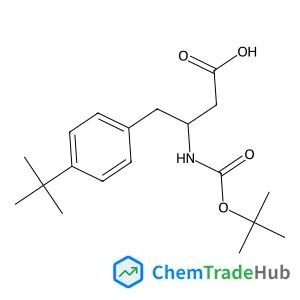
(S)-3-((tert-Butoxycarbonyl)amino)-4-(4-(tert-butyl)phenyl)butanoic acid
CAS番号:
403661-85-8
分子式:
C19H29NO4
おすすめサプライヤー



免責事項
このページに表示される学術雑誌情報は、参考および研究目的のみを目的としています。当社は雑誌出版社とは提携しておらず、投稿の取り扱いも行っておりません。出版に関するお問い合わせは、各雑誌出版社に直接ご連絡ください。
表示されている情報に誤りがある場合は、support@chemtradehub.com までご連絡ください。迅速に確認し、対応いたします。