


Loss of the preferential control over the striato-nigral direct pathway by striatal NMDA receptors in a rat model of Parkinson's disease
文献情報
出版日
2015-01-05
DOI
10.1039/C4AN01918K
インパクトファクター
4.616
著者
原文を見る
要旨
By using multi-probe microdialysis we previously demonstrated that endogenous glutamate differentially regulates the activity of the striatal output pathways in vivo, through N-methyl-D-aspartate (NMDA) receptors containing the GluN2A or GluN2B subunits. Using the same approach, we presently investigate whether reverse dialysis of NMDA in the striatum differentially affects GABA release in the striatum and in striatal target areas, i.e. globus pallidus (GP) and substantia nigra reticulata (SNr). Moreover, we ask whether this control is altered under parkinsonian conditions. Intrastriatal NMDA perfusion (10 min) evoked GABA release more potently in SNr (1–100 μM) than in other regions (10–100 μM), suggesting preferential control over striato-nigral projection neurons. Intrastriatal NMDA more potently stimulated glutamate levels in the striatum (1–100 μM) and SNr (1–10 μM) than in GP (10 μM). Striatal dopamine denervation with 6-hydroxydopamine caused a leftward shift in the NMDA concentration–response curve. Intrastriatal NMDA elevated GABA levels at 0.1 μM (all regions) and 1 μM (striatum and GP only), but not at higher concentrations, indicating that, compared to naïve animals, the GABA response in SNr was attenuated. Attenuation of the glutamate response was also observed in SNr (NMDA effective only at 0.1 μM). Conversely, the glutamate response in GP was widened (NMDA effective in the 0.1–1 μM range). We conclude that NMDA preferentially stimulates the activity of the striato-nigral direct pathway under physiological conditions. In Parkinson's disease, dopamine loss compromises the NMDA ability to stimulate striato-nigral neurons, thus shifting the NMDA control towards the striato-pallidal ones.
おすすめジャーナル

Journal of Natural Medicines

Organic Process Research & Development

Acta Materialia

Russian Journal of Applied Chemistry

New Journal of Chemistry

Russian Journal of General Chemistry

Drug Discovery Today

Current Opinion in Colloid & Interface Science

Russian Journal of Organic Chemistry

Russian Journal of Coordination Chemistry
関連文献
Central-ring functionalization and application of the rigid, aromatic, and H-shaped pentiptycene scaffold
Jye-Shane Yang, Jyu-Lun Yan
2008-02-14
Feature Article
DOI: 10.1039/B713428M
Viral capsids as templates for the production of monodisperse Prussian blue nanoparticles
Andrés de la Escosura, Martijn Verwegen, Friso D. Sikkema, Marta Comellas-Aragonès, Andrei Kirilyuk, Theo Rasing, Roeland J. M. Nolte, Jeroen J. L. M. Cornelissen
2008-02-25
Communication
DOI: 10.1039/B800936H
A novel mediator–polymer-modified anode for microbial fuel cells
Masanori Adachi, Tatsuo Shimomura, Makoto Komatsu, Hiroshi Yakuwa, Akiko Miya
2008-02-20
Communication
DOI: 10.1039/B717773A
Stabilization of cobalt oxyhydrate superconductor
Zhi Ren, Cao Wang, Xiang-fan Xu, Guang-han Cao, Zhu-an Xu, Yu-heng Zhang
2008-03-03
Communication
DOI: 10.1039/B800378E
Fluorescence microscopy coupled to electrochemistry: a powerful tool for the controlled electrochemical switch of fluorescent molecules
Fabien Miomandre, Rachel Meallet-Renault, Jean-Jacques Vachon, Robert Bernard Pansu, Pierre Audebert
2008-02-19
Communication
DOI: 10.1039/B718899D
Fully reversible guest exchange in tetraphosphonate cavitand complexes probed by fluorescence spectroscopy
Elisa Biavardi, Gionata Battistini, Marco Montalti, Roger M. Yebeutchou, Luca Prodi, Enrico Dalcanale
2008-03-05
Communication
DOI: 10.1039/B801729H
Nucleophilicities and carbon basicities of DBU and DBN‡
M. Baidya, Herbert Mayr
2008-03-13
Communication
DOI: 10.1039/B801811A
A near-infrared dye for multichannel imaging
Wellington Pham, Lauren Cassell, Amelie Gillman, Dmitry Koktysh, John C. Gore
2008-02-28
Communication
DOI: 10.1039/B719028J
Chromonic liquid crystals: properties and applications as functional materials
Suk-Wah Tam-Chang, Liming Huang
2008-01-07
Feature Article
DOI: 10.1039/B714319B
こちらもおすすめ
化合物よくある質問
4-アミノフェノール酸ナトリウム水和物とは何ですか?
4-アミノフェノール酸ナトリウム水和物は、CAS番号206557-08-6の化合物で、4-アミノフェノールとナトリウムが結合した塩と水和物です。この化合物は、白...
206557-08-64-Aminobenzoic acid ...
化合物よくある質問
Methyl 3-methyl-N-{[(2-methyl-2-propanyl)oxy]carbonyl}-L-histidinateの代替品はありますか?
この化合物は特定の合成プロセスに使用される可能性がありますが、代替品として、他の类似的な化合物、例えばMethyl 3-methyl-N-{[(2-methyl...
72212-51-2Methyl 3-methyl-N-{[...
化合物よくある質問
4-Boc-2-哌嗪甲酸の市場動向や研究トレンドはどうですか?
4-Boc-2-哌嗪甲酸は、薬品開発や合成化学分野で広く使用されており、その需要は継続的に推移しています。特に、新薬開発における合成化学分野での需要が高まってい...
192330-11-3(2R)-4-[(tert-butoxy...
化合物よくある質問
4,4'-二羟甲基联苯の物理化学的性質は何ですか?
4,4'-二羟甲基联苯のCAS番号は1667-12-5です。この化合物は白色の結晶粉末で、分子量は154.20です。水にわずかに溶けますが、アルコールや有機溶媒...
1667-12-54,4'-Biphenyldiyldim...
化合物よくある質問
5-甲硫基戊腈はどの業界で使用されていますか?
5-甲硫基戊腈は医薬品産業で使用される可能性があります。また、ポリマー合成の触媒として、センサー製造の一部として、半導体製造のプロセス改善に使用される可能性があ...
59121-25-45-(Methylsulfanyl)pe...
化合物よくある質問
CAS番号1311961-50-8の化合物はどのように合成されますか?
この化合物は、1-abieta-8,11,13-trien-19-イルと6'-メトキシシンコナナン-9-基を含有する窒素含有化合物から合成されます。一般的な合成...
1311961-50-81-Abieta-8,11,13-tri...
化合物よくある質問
6-ブロモベンジジミダゾール-2-カルビルデオキシドはどのように保存すればよいですか?
6-ブロモベンジジミダゾール-2-カルビルデオキシドは、避光・乾燥した容器(密閉容器)で-20℃~4℃の低温で保存してください。高温や直射日光、湿気は避けてくだ...
885280-26-25-Bromo-1H-benzimida...
化合物よくある質問
Boc-N-甲基氨甲环酸とは何ですか?
621-65-8のCAS番号を持つBoc-N-甲基氨甲环酸は、化学式C7H13NO5を有する化合物です。この化合物は白色の結晶性粉末で、吸湿性があります。
621-65-83-Hydroxy-1,2-propan...
化合物よくある質問
乙基三氟硼酸钾はどのように合成されますか?
乙基三氟硼酸钾は、トリフLUオール酸カリウムとエチルブロミドを反応させて合成されます。この反応は高い選択性と収率を持ち、触媒を用いることで効率的に進行します。
882871-21-8Potassium ethyltrifl...
化合物よくある質問
2-フロウロ-5-クロロ-4-アミノフェノールはどのように保存すればよいですか?
2-フロウロ-5-クロロ-4-アミノフェノールは、直射日光を避けて冷却された暗所で保存し、密閉容器に保管してください。温度は常温か低温が適しています。
847872-10-04-Amino-5-chloro-2-f...
掲載誌
Analyst

CiteScore:
7.8
自己引用率:
5.6%
年間論文数:
653
Analyst publishes analytical and bioanalytical research that reports premier fundamental discoveries and inventions, and the applications of those discoveries, unconfined by traditional discipline barriers.
おすすめ化合物
![2-[(5Z,8Z,11Z,14Z)-5,8,11,14-Icosatetraen-1-yloxy]-1,3-propanediol structure](https://static.chemtradehub.com/structs/222/222723-55-9-0348.webp "2-[(5Z,8Z,11Z,14Z)-5,8,11,14-Icosatetraen-1-yloxy]-1,3-propanediol structure")
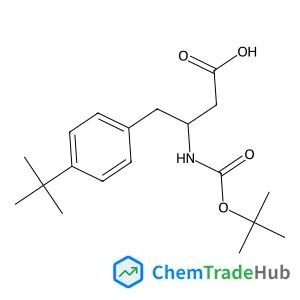
(S)-3-((tert-Butoxycarbonyl)amino)-4-(4-(tert-butyl)phenyl)butanoic acid
CAS番号:
403661-85-8
分子式:
C19H29NO4
おすすめサプライヤー





免責事項
このページに表示される学術雑誌情報は、参考および研究目的のみを目的としています。当社は雑誌出版社とは提携しておらず、投稿の取り扱いも行っておりません。出版に関するお問い合わせは、各雑誌出版社に直接ご連絡ください。
表示されている情報に誤りがある場合は、support@chemtradehub.com までご連絡ください。迅速に確認し、対応いたします。