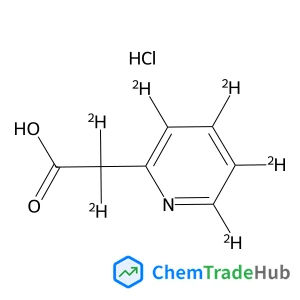
2,2-dideuterio-2-(3,4,5,6-tetradeuterio-2-pyridyl)acetic acid;hydrochloride
CAS番号:
1329799-67-8
分子式:
C7H2ClD6NO2
Ting Li, Tianyuan Ci, Liang Chen, Lin Yu, Jiandong Ding
A diblock copolymer of methoxy poly(ethylene glycol) and poly(DL-lactide-co-glycolide) (MPEG–PLGA) was synthesized via ring-opening polymerization. Its aqueous system over the critical gelation concentration underwent a gel-to-sol transition with increasing the temperature. More interestingly, gel-to-sol-to-(reentrant gel) transitions upon heating were found in the presence of salts. The reentrant gel and virgin gel exhibited different viscoelasticities, as revealed by dynamic rheological measurements, and different microstructures displayed in cryo-SEM images. Based on the observations of micelle formation at low copolymer concentrations and NMR detections at high concentrations etc., we anticipated that the virgin gel was formed by the jamming of close-packed micelles and the reentrant gel had, as a thermogel, an internal structure of a percolated micelle network. The phase transition temperatures varied with the salt concentration, and depended also on the type of ion, with the trend obeying the Hofmeister series.

Journal of Natural Medicines

Current Opinion in Solid State & Materials Science

Chemistry Education Research and Practice

Russian Journal of Organic Chemistry

Saudi Pharmaceutical Journal

Russian Chemical Bulletin

Journal of Peptide Science

Current Opinion in Colloid & Interface Science

Journal of Saudi Chemical Society

Crystallography Reports
Arthur Turkin, Pavel Malý
DOI: 10.1039/D1CP02136B
Zachary Morrow, Hyuk-Yong Kwon, C. T. Kelley, Elena Jakubikova
DOI: 10.1039/D1CP03446D
Gerui Pei, Cong-Cong Shu, Mengyang Li, Zhong-Ming Sun, Tao Yang
DOI: 10.1039/D1CP01592C
Chao Wu
DOI: 10.1039/D1CP02764F
Joharimanitra Randrianandraina, Michael Badawi, Bruno Cardey, Manuel Grivet, Jean-Emmanuel Groetz, Christophe Ramseyer, Freddy Torrealba Anzola, Caroline Chambelland, Didier Ducret
DOI: 10.1039/D1CP02624K
Luisa Weirich, Christian Merten
DOI: 10.1039/D1CP01846A
Sharmin Akter, Jorge A. Vargas, Kamal Sharkas, Juan E. Peralta, Koblar A. Jackson
DOI: 10.1039/D0CP06512A
Dominik Legut
DOI: 10.1039/D1CP02754A
Pandurangan Kalipillai, Ethayaraja Mani
DOI: 10.1039/D1CP01652K
CAS番号163217-74-1の「邻羟基阿托伐他汀内酯标准品」は、GHS分類では危険物に分類されず、主にREACH規則とFDA/EPAの管理対象となります。R...
メチル(3R)-3-アミノ-2,3-ジヒドロ-1-ベンゾファンラニン-5-カルボイル酸塩塩酸塩は、医薬品や合成化学の研究に広く用いられます。また、特定の薬物の前...
トランス-4-メチルピロリジン-3-オール塩酸塩は、4-メチルピロリジンの塩酸塩化によって合成されます。一般的な合成方法では、4-メチルピロリジンを塩酸に加えて...
硫雜環丁烷-1,1-二氧化物は安全ではありません。毒性は報告されていませんが、高温下で分解し、可燃性があるため、高圧ガスは注意が必要です。密閉した容器で保管し、...
9-ヒドロキシエリプチシネ塩酸塩は、エリプチシネから塩酸を添加することで合成されます。選択性は高いですが、収率は約70%です。
5-塩素-2-(メチルアミノ)フェニル-(2-塩素フェニル)メタン酮のCAS番号は5621-86-3です。この化合物は白色の結晶性粉末で、分子量は415.03で...
1-[2-(4-甲氧基-苯氧基)-乙基]-哌嗪は、直射日光を避けて暗所に、室温(15-25℃)で保管し、密閉容器に入れることで安定性を保つことができます。
2-[3-(4-甲氧基フェニル)プロピル]-4,4,5,5-四メチル-1,3,2-ドイボロロールアンは、医薬品の合成、有機合成化学、および新材料の研究で使用され...

Polymer Chemistry welcomes submissions in all areas of polymer science that have a strong focus on macromolecular chemistry. Manuscripts may cover a broad range of fields, yet no direct application focus is required.
![(2E)-3-(3-Chlorophenyl)-N-{2-[4-(methylsulfonyl)-1-piperazinyl]-2-oxoethyl}acrylamide structure](https://static.chemtradehub.com/structs/250/2505001-54-5-c1e9.webp "(2E)-3-(3-Chlorophenyl)-N-{2-[4-(methylsulfonyl)-1-piperazinyl]-2-oxoethyl}acrylamide structure")