


A comparative study of polymers containing naphthodifuranone and benzodifuranone units in the main chain
文献情報
出版日
2013-09-30
DOI
10.1039/C3PY01101A
インパクトファクター
5.582
著者
Haichang Zhang, Jun Zhang, Bernd Tieke
原文を見る
要旨
The synthesis of two new polymers containing the naphtho[2,1-b:3,4-b′]difuran-2,9-dione (1,10-NDF) or the ortho-benzo[1,2-b:6,5-b′]difuran-2,7-dione (1,8-BDF) chromophore in the main chain is described. The polymers P1 and P2′ were prepared upon Suzuki coupling of either 3-(4-bromophenyl)-8-(3-bromo-4,5-dimethoxyphenyl)-naphtho[2,1-b:3,4-b′]difuran-2,9-dione (M1) or 3,6-bis(4-bromophenyl)-1,2,3,5,6,7-hexahydrobenzo[1,2-b:6,5-b′]difuran-2,7-dione (M2′) and 2,2-(9,9-dioctyl-9H-fluorene-2,7-diyl-)bis(4,4,5,5-tetramethyl-1,3,2-dioxaborolane) (M3), respectively. P2′ was subsequently converted into the oxidized form P2 upon reaction with nitrobenzene. Optical and electrochemical properties of P1 and P2 are described and compared with the properties of previously prepared polymer P3, which was synthesized upon Suzuki coupling of symmetrical 3,8-bis(4-bromophenyl)naphtho[2,1-b:3,4-b′]difuran-2,9-dione (M4) and M3. While the NDF-based polymers P1 and P3 exhibit absorption maxima around 480 nm, the BDF-based polymer P2 shows a maximum at 555 nm. Quantum chemical studies by the density functional theory method show that the BDF-based polymer is more planar than the polymers based on NDF. The excitation of the polymers causes a strong electron transfer from the backbone to the NDF/BDF core units. 1,10-NDF-based polymers exhibit excellent photostability in UV-light, while the 1,8-BDF-based polymer is less stable, if irradiated with a 200 W Hg lamp. All polymers exhibit low band gaps of 1.31 to 1.66 eV.
おすすめジャーナル

Crystallography Reports

Current Opinion in Colloid & Interface Science

Drug Discovery Today

Saudi Pharmaceutical Journal

Russian Journal of General Chemistry

Russian Journal of Coordination Chemistry

Russian Journal of Organic Chemistry

Chemical Communications

Chemistry Education Research and Practice

Current Opinion in Solid State & Materials Science
関連文献
Chalcone derivatives as highly versatile photoinitiators for radical, cationic, thiol–ene and IPN polymerization reactions upon exposure to visible light
Mohamad-Ali Tehfe, Frédéric Dumur, Pu Xiao, Marie Delgove, Bernadette Graff, Jean-Pierre Fouassier, Didier Gigmes, Jacques Lalevée
2013-08-20
Paper
DOI: 10.1039/C3PY00922J
Scalable synthesis and derivation of functional polyesters bearing ene and epoxide side chains
Yunfeng Yan, Daniel J. Siegwart
2013-11-13
Paper
DOI: 10.1039/C3PY01474F
An injectable hyaluronic acid/PEG hydrogel for cartilage tissue engineering formed by integrating enzymatic crosslinking and Diels–Alder “click chemistry”
2013-08-09
Paper
DOI: 10.1039/C3PY00869J
Synthesis of well-defined amphiphilic branched polyethylene-graft-poly (N-isopropylacrylamide) copolymers by coordination copolymerization in tandem with RAFT polymerization and their self-assembled vesicles
Ye Zhao, Haiyang Gao, Guodong Liang, Fangming Zhu, Qing Wu
2013-09-27
Paper
DOI: 10.1039/C3PY01289A
Direct synthesis of poly(p-phenyleneethynylene)s from calcium carbide
Nopparat Thavornsin, Mongkol Sukwattanasinitt, Sumrit Wacharasindhu
2013-08-12
Communication
DOI: 10.1039/C3PY01068F
A novel route for polymerisation of thiophene based conducting polymers using trace-free oxidants
Jimy Hadiono So, David Mayevsky, Orawan Winther-Jensen, Bjorn Winther-Jensen
2013-10-10
Communication
DOI: 10.1039/C3PY01265D
Manganese(iii) acetylacetonate initiated RAFT polymerizations: an alternative and versatile RAFT initiator
Zhigui Zheng, Yuan Zhou, Zhengbiao Zhang, Xiulin Zhu
2013-07-31
Communication
DOI: 10.1039/C3PY00879G
A biomimic pH-sensitive polymeric prodrug based on polycarbonate for intracellular drug delivery
Haibo Wang, Yin Wang, Yangjun Chen, Qiao Jin, Jian Ji
2013-09-09
Paper
DOI: 10.1039/C3PY00861D
こちらもおすすめ
28770-01-62-(2-Isopropyl-1,3-o...
化合物よくある質問
「邻羟基阿托伐他汀内酯标准品」に適用される法規ガイドelinesは何ですか?
CAS番号163217-74-1の「邻羟基阿托伐他汀内酯标准品」は、GHS分類では危険物に分類されず、主にREACH規則とFDA/EPAの管理対象となります。R...
163217-74-1ortho-Hydroxy Atorva...
化合物よくある質問
メチル(3R)-3-アミノ-2,3-ジヒドロ-1-ベンゾファンラニン-5-カルボイル酸塩塩酸塩の主な用途は何ですか?
メチル(3R)-3-アミノ-2,3-ジヒドロ-1-ベンゾファンラニン-5-カルボイル酸塩塩酸塩は、医薬品や合成化学の研究に広く用いられます。また、特定の薬物の前...
2241594-15-8Methyl (3R)-3-amino-...
化合物よくある質問
トランス-4-メチルピロリジン-3-オール塩酸塩はどのように合成されますか?
トランス-4-メチルピロリジン-3-オール塩酸塩は、4-メチルピロリジンの塩酸塩化によって合成されます。一般的な合成方法では、4-メチルピロリジンを塩酸に加えて...
265108-42-7trans-4-Methylpyrrol...
化合物よくある質問
硫雜環丁烷-1,1-二氧化物は安全ですか?
硫雜環丁烷-1,1-二氧化物は安全ではありません。毒性は報告されていませんが、高温下で分解し、可燃性があるため、高圧ガスは注意が必要です。密閉した容器で保管し、...
5687-92-3Thietane 1,1-dioxide
6054-10-02H, 8H-Benzo[1,2-b
化合物よくある質問
9-ヒドロキシエリプチシネ塩酸塩はどのように合成されますか?
9-ヒドロキシエリプチシネ塩酸塩は、エリプチシネから塩酸を添加することで合成されます。選択性は高いですが、収率は約70%です。
52238-35-49-Hydroxyellipticine...
化合物よくある質問
5-塩素-2-(メチルアミノ)フェニル-(2-塩素フェニル)メタン酮の物理化学的性質は何ですか?
5-塩素-2-(メチルアミノ)フェニル-(2-塩素フェニル)メタン酮のCAS番号は5621-86-3です。この化合物は白色の結晶性粉末で、分子量は415.03で...
5621-86-3[5-Chloro-2-(methyla...
化合物よくある質問
1-[2-(4-甲氧基-苯氧基)-乙基]-哌嗪はどのように保存すればよいですか?
1-[2-(4-甲氧基-苯氧基)-乙基]-哌嗪は、直射日光を避けて暗所に、室温(15-25℃)で保管し、密閉容器に入れることで安定性を保つことができます。
117132-44-21-[2-(4-Methoxy-phen...
化合物よくある質問
2-[3-(4-甲氧基フェニル)プロピル]-4,4,5,5-四メチル-1,3,2-ドイボロロールアンの主な用途は何ですか?
2-[3-(4-甲氧基フェニル)プロピル]-4,4,5,5-四メチル-1,3,2-ドイボロロールアンは、医薬品の合成、有機合成化学、および新材料の研究で使用され...
1073371-72-82-[3-(4-Methoxypheny...
掲載誌
Polymer Chemistry

CiteScore:
8.6
自己引用率:
7.3%
年間論文数:
457
Polymer Chemistry welcomes submissions in all areas of polymer science that have a strong focus on macromolecular chemistry. Manuscripts may cover a broad range of fields, yet no direct application focus is required.
おすすめ化合物
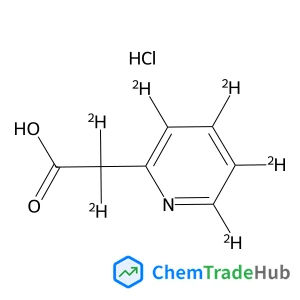
2,2-dideuterio-2-(3,4,5,6-tetradeuterio-2-pyridyl)acetic acid;hydrochloride
CAS番号:
1329799-67-8
分子式:
C7H2ClD6NO2
おすすめサプライヤー





免責事項
このページに表示される学術雑誌情報は、参考および研究目的のみを目的としています。当社は雑誌出版社とは提携しておらず、投稿の取り扱いも行っておりません。出版に関するお問い合わせは、各雑誌出版社に直接ご連絡ください。
表示されている情報に誤りがある場合は、support@chemtradehub.com までご連絡ください。迅速に確認し、対応いたします。