


Absolut “copper catalyzation perfected”; robust living polymerization of NIPAM: Guinness is good for SET-LRP
文献情報
出版日
2013-09-11
DOI
10.1039/C3PY01075A
インパクトファクター
5.582
著者
Christopher Waldron, Qiang Zhang, Zaidong Li, Vasiliki Nikolaou, Gabit Nurumbetov, Jamie Godfrey, Ronan McHale, Gokhan Yilmaz, Rajan K. Randev, Mony Girault, Kayleigh McEwan, David M. Haddleton, Martijn Droesbeke, Alice J. Haddleton, Paul Wilson, Alexandre Simula, Jennifer Collins, Danielle J. Lloyd, James A. Burns, Christopher Summers, Claudia Houben, Athina Anastasaki, Muxiu Li, C. Remzi Becer, Jenny K. Kiviaho, Nuttapol Risangud
原文を見る
要旨
The controlled polymerization of N-isopropyl acrylamide (NIPAM) is reported in a range of international beers, wine, ciders and spirits utilizing Cu(0)-mediated living radical polymerization (SET-LRP). Highly active Cu(0) is first formed in situ by the rapid disproportionation of [Cu(I)(Me6-Tren)Br] in the commercial water–alcohol mixtures. Rapid, yet highly controlled, radical polymerization follows (Đ values as low as 1.05) despite the numerous chemicals of diverse functionality present in these solvents e.g. alpha acids, sugars, phenols, terpenoids, flavonoids, tannins, metallo-complexes, anethole etc. The results herein demonstrate the robust nature of the aqueous SET-LRP protocol, underlining its ability to operate efficiently in a wide range of complex chemical environments.
おすすめジャーナル

Russian Journal of Bioorganic Chemistry

Russian Journal of Coordination Chemistry

Russian Journal of Organic Chemistry

Organic Process Research & Development

Russian Journal of Applied Chemistry

Nature Medicine

New Journal of Chemistry

Acta Materialia

Drug Discovery Today

Current Opinion in Colloid & Interface Science
関連文献
Nonvolatile organic field-effect transistor memory devices using polymer electrets with different thiophene chain lengths
Ying-Hsuan Chou, Sanae Takasugi, Raita Goseki, Takashi Ishizone, Wen-Chang Chen
2013-10-14
Paper
DOI: 10.1039/C3PY01124K
Multi-stimuli responsive supramolecular diblock copolymers
L. Sambe, F. Stoffelbach, J. Lyskawa, F. Delattre, M. Bria, F. X. Sauvage, M. Sliwa, V. Humblot, B. Charleux, G. Cooke, P. Woisel
2013-10-03
Paper
DOI: 10.1039/C3PY01093G
Biohybrid structures consisting of biotinylated glycodendrimers and proteins: influence of the biotin ligand's number and chemical nature on the biotin–avidin conjugation
Susanne Boye, Mihaela Cernescu, Hartmut Komber, Bernhard Brutschy, Dietmar Appelhans
2013-10-17
Paper
DOI: 10.1039/C3PY01152F
The use of a carbon paste electrode mixed with multiwalled carbon nanotube/electroactive polyimide composites as an electrode for sensing ascorbic acid
Tsao-Cheng Huang, Lu-Chen Yeh, Hsiu-Ying Huang, Zheng-Yong Nian, Yi-Chun Yeh, Yi-Chen Chou, Jui-Ming Yeh, Mei-Hui Tsai
2013-09-05
Paper
DOI: 10.1039/C3PY00787A
Porphyrin-containing hyperbranched supramolecular polymers: enhancing 1O2-generation efficiency by supramolecular polymerization
Yiliu Liu, Zehuan Huang, Kai Liu, Hans Kelgtermans, Wim Dehaen, Zhiqiang Wang, Xi Zhang
2013-08-22
Communication
DOI: 10.1039/C3PY01036H
Hyperbranched polyisobutylenes for self-healing polymers
D. Döhler, P. Zare, W. H. Binder
2013-10-03
Paper
DOI: 10.1039/C3PY01151H
Nitroxide mediated polymerization of methacrylates at moderate temperature
Christophe Detrembleur, Christine Jérôme, Julien De Winter, Pascal Gerbaux, Jean-Louis Clément, Yohann Guillaneuf, Didier Gigmes
2013-09-17
Communication
DOI: 10.1039/C3PY01133J
Polymer-modified gold nanoparticles via RAFT polymerization: a detailed study for a biosensing application
Masaki Takara, Masayuki Toyoshima, Hirokazu Seto, Yu Hoshino, Yoshiko Miura
2013-09-20
Paper
DOI: 10.1039/C3PY01001E
Fluoro-benzoselenadiazole-based low band gap polymers for high efficiency organic solar cells
Yongxi Li, Zhe Pan, Lei Miao, Ying Xing, Chao Li, Yu Chen
2013-08-22
Communication
DOI: 10.1039/C3PY01018J
Synthesis and evaluation of thermally-responsive coatings based upon Diels–Alder chemistry and renewable materials
Dahlia N. Amato, Gregory A. Strange, John P. Swanson, Anton D. Chavez, Suzanne E. Roy, Kim L. Varney, Craig A. Machado, Douglas V. Amato, Philip J. Costanzo
2013-08-20
Paper
DOI: 10.1039/C3PY01024D
こちらもおすすめ
28770-01-62-(2-Isopropyl-1,3-o...
化合物よくある質問
「邻羟基阿托伐他汀内酯标准品」に適用される法規ガイドelinesは何ですか?
CAS番号163217-74-1の「邻羟基阿托伐他汀内酯标准品」は、GHS分類では危険物に分類されず、主にREACH規則とFDA/EPAの管理対象となります。R...
163217-74-1ortho-Hydroxy Atorva...
化合物よくある質問
メチル(3R)-3-アミノ-2,3-ジヒドロ-1-ベンゾファンラニン-5-カルボイル酸塩塩酸塩の主な用途は何ですか?
メチル(3R)-3-アミノ-2,3-ジヒドロ-1-ベンゾファンラニン-5-カルボイル酸塩塩酸塩は、医薬品や合成化学の研究に広く用いられます。また、特定の薬物の前...
2241594-15-8Methyl (3R)-3-amino-...
化合物よくある質問
トランス-4-メチルピロリジン-3-オール塩酸塩はどのように合成されますか?
トランス-4-メチルピロリジン-3-オール塩酸塩は、4-メチルピロリジンの塩酸塩化によって合成されます。一般的な合成方法では、4-メチルピロリジンを塩酸に加えて...
265108-42-7trans-4-Methylpyrrol...
化合物よくある質問
硫雜環丁烷-1,1-二氧化物は安全ですか?
硫雜環丁烷-1,1-二氧化物は安全ではありません。毒性は報告されていませんが、高温下で分解し、可燃性があるため、高圧ガスは注意が必要です。密閉した容器で保管し、...
5687-92-3Thietane 1,1-dioxide
6054-10-02H, 8H-Benzo[1,2-b
化合物よくある質問
9-ヒドロキシエリプチシネ塩酸塩はどのように合成されますか?
9-ヒドロキシエリプチシネ塩酸塩は、エリプチシネから塩酸を添加することで合成されます。選択性は高いですが、収率は約70%です。
52238-35-49-Hydroxyellipticine...
化合物よくある質問
5-塩素-2-(メチルアミノ)フェニル-(2-塩素フェニル)メタン酮の物理化学的性質は何ですか?
5-塩素-2-(メチルアミノ)フェニル-(2-塩素フェニル)メタン酮のCAS番号は5621-86-3です。この化合物は白色の結晶性粉末で、分子量は415.03で...
5621-86-3[5-Chloro-2-(methyla...
化合物よくある質問
1-[2-(4-甲氧基-苯氧基)-乙基]-哌嗪はどのように保存すればよいですか?
1-[2-(4-甲氧基-苯氧基)-乙基]-哌嗪は、直射日光を避けて暗所に、室温(15-25℃)で保管し、密閉容器に入れることで安定性を保つことができます。
117132-44-21-[2-(4-Methoxy-phen...
化合物よくある質問
2-[3-(4-甲氧基フェニル)プロピル]-4,4,5,5-四メチル-1,3,2-ドイボロロールアンの主な用途は何ですか?
2-[3-(4-甲氧基フェニル)プロピル]-4,4,5,5-四メチル-1,3,2-ドイボロロールアンは、医薬品の合成、有機合成化学、および新材料の研究で使用され...
1073371-72-82-[3-(4-Methoxypheny...
掲載誌
Polymer Chemistry

CiteScore:
8.6
自己引用率:
7.3%
年間論文数:
457
Polymer Chemistry welcomes submissions in all areas of polymer science that have a strong focus on macromolecular chemistry. Manuscripts may cover a broad range of fields, yet no direct application focus is required.
おすすめ化合物

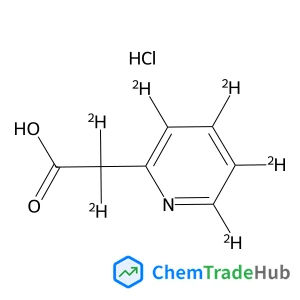
2,2-dideuterio-2-(3,4,5,6-tetradeuterio-2-pyridyl)acetic acid;hydrochloride
CAS番号:
1329799-67-8
分子式:
C7H2ClD6NO2
![(2E)-3-(3-Chlorophenyl)-N-{2-[4-(methylsulfonyl)-1-piperazinyl]-2-oxoethyl}acrylamide structure](https://static.chemtradehub.com/structs/250/2505001-54-5-c1e9.webp "(2E)-3-(3-Chlorophenyl)-N-{2-[4-(methylsulfonyl)-1-piperazinyl]-2-oxoethyl}acrylamide structure")
(2E)-3-(3-Chlorophenyl)-N-{2-[4-(methylsulfonyl)-1-piperazinyl]-2-oxoethyl}acrylamide
CAS番号:
2505001-54-5
分子式:
C16H20ClN3O4S
おすすめサプライヤー






免責事項
このページに表示される学術雑誌情報は、参考および研究目的のみを目的としています。当社は雑誌出版社とは提携しておらず、投稿の取り扱いも行っておりません。出版に関するお問い合わせは、各雑誌出版社に直接ご連絡ください。
表示されている情報に誤りがある場合は、support@chemtradehub.com までご連絡ください。迅速に確認し、対応いたします。