













The relationship between the degree of branching and glass transition temperature of branched polyethylene: experiment and simulation
文献情報
出版日
2013-10-23
DOI
10.1039/C3PY00896G
インパクトファクター
5.582
著者
Xiang Luo, Shijie Xie, Jun Liu, Haibin Hu, Jing Jiang, Wei Huang, Haiyang Gao, Dongshan Zhou, Zhongyuan Lü, Deyue Yan
原文を見る
要旨
Polyethylene (PE) samples with similar number-averaged molecular weight but various degrees of branching (DBs) were synthesized by means of ethylene coordination polymerization catalyzed by an amine–imine nickel catalyst or α-diimine palladium catalyst, respectively. Different from the conventional DB of branched PE, here we calculated the DB according to the equation proposed by Hawker et al., i.e., DB is the ratio of the number of dendritic units (–CHCH2–) and terminal units (–CH2CH3) to the number of all units (dendritic, terminal and linear units (–CH2CH2–)) in the PE backbone and branches. The glass transition temperature (Tg) of the prepared PE samples was studied by dynamic mechanical analysis (DMA), differential scanning calorimetry (DSC) and ultra-fast differential scanning calorimetry (UF-DSC). The DSC data show that the crystallization and the glass transition processes of branched PE samples are correlated with each other, and both the melting temperature and the glass transition temperature decreased with increasing DB. The UF-DSC results show that the crystallization of the PE samples with high DB can be prevented when the cooling rate in calorimetry is high enough. For example, the crystallization peak of branched PE with DB = 0.310 totally disappears when the cooling rate in calorimetry reaches more than 5000 K s−1 and only a glass transition takes place at −51.3 °C. Furthermore, correlation between the glass transition temperature and the DB of branched PE has been well established by atomistic molecular dynamics (MD) simulations. The values of MD-determined Tg are in good agreement with experimental results. The difference of free volume in PE systems with different DBs, which is reflected by the calculated radial distribution function, is the reason for the observed change of Tg on DB.
関連文献
A Dirac nodal surface semi-metallic carbon-based structure as a universal anode material for metal-ion batteries with high performance
Shouren Zhang, Huili Liu, Yadan Zhang, Shuaiwei Wang, Baocheng Yang
2021-08-06
Paper
DOI: 10.1039/D1CP02306C
Theoretical assessment of Raman spectra on MXene Ti2C: from monolayer to bilayer
Weiliang Wang
2021-08-18
Paper
DOI: 10.1039/D1CP03117A
Exploration on the drug solubility enhancement in aqueous medium with the help of endo-functionalized molecular tubes: a computational approach
Rabindranath Paul, Sandip Paul
2021-08-09
Paper
DOI: 10.1039/D1CP01187A
A photoelectron imaging study of the deprotonated GFP chromophore anion and RNA fluorescent tags
Joanne L. Woodhouse, Alice Henley, Ross Lewin, John M. Ward, Helen C. Hailes, Anastasia V. Bochenkova, Helen H. Fielding
2021-08-20
Paper
DOI: 10.1039/D1CP01901E
UVPD spectroscopy of differential mobility-selected prototropic isomers of protonated adenine
Mircea Guna, Bradley B. Schneider, J. C. Yves Le Blanc, Marcel Nooijen
2021-08-30
Paper
DOI: 10.1039/D1CP02688G
Fitting potential energy and induced dipole surfaces of the van der Waals complex CH4–N2 using non-product quadrature grids
Yulia N. Kalugina, Iouli E. Gordon
2021-08-04
Paper
DOI: 10.1039/D1CP02161C
Specific chemical bond relaxation unraveled by analysis of shake-up satellites in the oxygen single site double core hole spectrum of CO2
Anthony Ferté, Francis Penent, Jérôme Palaudoux, Hiroshi Iwayama, Eiji Shigemasa, Yasumasa Hikosaka, Kouichi Soejima, Pascal Lablanquie, Richard Taïeb, Stéphane Carniato
2021-11-22
Paper
DOI: 10.1039/D1CP03947D
Factors controlling the molecular modification of one-dimensional zeolites
William A. Elliott, R. John Clark, James G. Sutjianto, Jeremy C. Palmer, Jeffrey D. Rimer
2021-08-06
Paper
DOI: 10.1039/D1CP02619D
Defect evolution behaviors from single sulfur point vacancies to line vacancies in monolayer molybdenum disulfide
Xiaoyong Yang, Ming Jiang, Lixin Chen, Zhiwen Chen
2021-08-10
Paper
DOI: 10.1039/D1CP02852A
こちらもおすすめ
28770-01-62-(2-Isopropyl-1,3-o...
化合物よくある質問
「邻羟基阿托伐他汀内酯标准品」に適用される法規ガイドelinesは何ですか?
CAS番号163217-74-1の「邻羟基阿托伐他汀内酯标准品」は、GHS分類では危険物に分類されず、主にREACH規則とFDA/EPAの管理対象となります。R...
163217-74-1ortho-Hydroxy Atorva...
化合物よくある質問
メチル(3R)-3-アミノ-2,3-ジヒドロ-1-ベンゾファンラニン-5-カルボイル酸塩塩酸塩の主な用途は何ですか?
メチル(3R)-3-アミノ-2,3-ジヒドロ-1-ベンゾファンラニン-5-カルボイル酸塩塩酸塩は、医薬品や合成化学の研究に広く用いられます。また、特定の薬物の前...
2241594-15-8Methyl (3R)-3-amino-...
化合物よくある質問
トランス-4-メチルピロリジン-3-オール塩酸塩はどのように合成されますか?
トランス-4-メチルピロリジン-3-オール塩酸塩は、4-メチルピロリジンの塩酸塩化によって合成されます。一般的な合成方法では、4-メチルピロリジンを塩酸に加えて...
265108-42-7trans-4-Methylpyrrol...
化合物よくある質問
硫雜環丁烷-1,1-二氧化物は安全ですか?
硫雜環丁烷-1,1-二氧化物は安全ではありません。毒性は報告されていませんが、高温下で分解し、可燃性があるため、高圧ガスは注意が必要です。密閉した容器で保管し、...
5687-92-3Thietane 1,1-dioxide
6054-10-02H, 8H-Benzo[1,2-b
化合物よくある質問
9-ヒドロキシエリプチシネ塩酸塩はどのように合成されますか?
9-ヒドロキシエリプチシネ塩酸塩は、エリプチシネから塩酸を添加することで合成されます。選択性は高いですが、収率は約70%です。
52238-35-49-Hydroxyellipticine...
化合物よくある質問
5-塩素-2-(メチルアミノ)フェニル-(2-塩素フェニル)メタン酮の物理化学的性質は何ですか?
5-塩素-2-(メチルアミノ)フェニル-(2-塩素フェニル)メタン酮のCAS番号は5621-86-3です。この化合物は白色の結晶性粉末で、分子量は415.03で...
5621-86-3[5-Chloro-2-(methyla...
化合物よくある質問
1-[2-(4-甲氧基-苯氧基)-乙基]-哌嗪はどのように保存すればよいですか?
1-[2-(4-甲氧基-苯氧基)-乙基]-哌嗪は、直射日光を避けて暗所に、室温(15-25℃)で保管し、密閉容器に入れることで安定性を保つことができます。
117132-44-21-[2-(4-Methoxy-phen...
化合物よくある質問
2-[3-(4-甲氧基フェニル)プロピル]-4,4,5,5-四メチル-1,3,2-ドイボロロールアンの主な用途は何ですか?
2-[3-(4-甲氧基フェニル)プロピル]-4,4,5,5-四メチル-1,3,2-ドイボロロールアンは、医薬品の合成、有機合成化学、および新材料の研究で使用され...
1073371-72-82-[3-(4-Methoxypheny...
掲載誌
Polymer Chemistry

CiteScore:
8.6
自己引用率:
7.3%
年間論文数:
457
Polymer Chemistry welcomes submissions in all areas of polymer science that have a strong focus on macromolecular chemistry. Manuscripts may cover a broad range of fields, yet no direct application focus is required.
おすすめ化合物
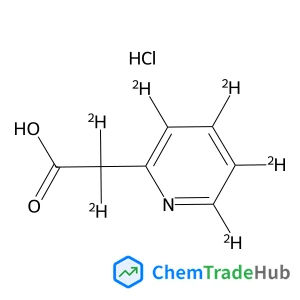
2,2-dideuterio-2-(3,4,5,6-tetradeuterio-2-pyridyl)acetic acid;hydrochloride
CAS番号:
1329799-67-8
分子式:
C7H2ClD6NO2
![(2E)-3-(3-Chlorophenyl)-N-{2-[4-(methylsulfonyl)-1-piperazinyl]-2-oxoethyl}acrylamide structure](https://static.chemtradehub.com/structs/250/2505001-54-5-c1e9.webp "(2E)-3-(3-Chlorophenyl)-N-{2-[4-(methylsulfonyl)-1-piperazinyl]-2-oxoethyl}acrylamide structure")
(2E)-3-(3-Chlorophenyl)-N-{2-[4-(methylsulfonyl)-1-piperazinyl]-2-oxoethyl}acrylamide
CAS番号:
2505001-54-5
分子式:
C16H20ClN3O4S

phosphoryl}methyl 4-methylbenzenesulfonate structure](https://static.chemtradehub.com/structs/864/864068-45-1-ba7c.webp "{[3-(Hexadecyloxy)propoxy](hydroxy)phosphoryl}methyl 4-methylbenzenesulfonate structure")
{[3-(Hexadecyloxy)propoxy](hydroxy)phosphoryl}methyl 4-methylbenzenesulfonate
CAS番号:
864068-45-1
分子式:
C27H49O7PS
おすすめサプライヤー




免責事項
このページに表示される学術雑誌情報は、参考および研究目的のみを目的としています。当社は雑誌出版社とは提携しておらず、投稿の取り扱いも行っておりません。出版に関するお問い合わせは、各雑誌出版社に直接ご連絡ください。
表示されている情報に誤りがある場合は、support@chemtradehub.com までご連絡ください。迅速に確認し、対応いたします。