












![N-[2-(4-Hydroxyphenoxy)-4-nitrophenyl]methanesulfonamide structure](https://static.chemtradehub.com/structs/109/109032-22-6-7c88.webp "N-[2-(4-Hydroxyphenoxy)-4-nitrophenyl]methanesulfonamide structure")
Graphene mechanics: II. Atomic stress distribution during indentation until rupture
文献情報
出版日
2014-04-15
DOI
10.1039/C3CP55341H
インパクトファクター
3.676
著者
Bogdan I. Costescu
原文を見る
要旨
Previous Atomic Force Microscopy (AFM) experiments found single layers of defect-free graphene to rupture at unexpectedly high loads in the micronewton range. Using molecular dynamics simulations, we modeled an AFM spherical tip pressing on a circular graphene sheet and studied the stress distribution during the indentation process until rupture. We found the graphene rupture force to have no dependency on the sheet size and a very weak dependency on the indenter velocity, allowing a direct comparison to experiment. The deformation showed a non-linear elastic behavior, with a two-dimensional elastic modulus in good agreement with previous experimental and computational studies. In line with theoretical predictions for linearly elastic sheets, rupture forces of non-linearly elastic graphene are proportional to the tip radius. However, as a deviation from the theory, the atomic stress concentrates under the indenter tip more strongly than predicted and causes a high probability of bond breaking only in this area. In turn, stress levels decrease rapidly towards the edge of the sheet, most of which thus only serves the role of mechanical support for the region under the indenter. As a consequence, the high ratio between graphene sheets and sphere radii, hitherto supposed to be necessary for reliable deformation and rupture studies, could be reduced to a factor of only 5–10 without affecting the outcome. Our study suggests time-resolved analysis of forces at the atomic level as a valuable tool to predict and interpret the nano-scale response of stressed materials beyond graphene.
おすすめジャーナル
関連文献
Enantio- and diastereoselective synthesis of tetrahydrofuro[2,3-b]furan-2(3H)-one derivatives and related oxygen heterocycles via an asymmetric organocatalytic cascade process
Wei-Wei Zhao
2017-08-28
Research Article
DOI: 10.1039/C7QO00621G
Synthesis of pyrazolo[5,1-a]isoquinolines through copper-catalyzed regioselective bicyclization of N-propargylic sulfonylhydrazones
Hai-Tao Tang, Jia-Hao Zeng, Jun-Jia Chen, Yun-Bing Zhou, Ren-Hao Li, Zhuang-Ping Zhan
2017-04-27
Research Article
DOI: 10.1039/C7QO00249A
Multifunctional odorless isocyano(triphenylphosphoranylidene)-acetates: synthesis and direct one-pot four-component Ugi/Wittig cyclization to multisubstituted oxazoles
Zhi-Lin Ren, Zhi-Rong Guan, Han-Han Kong, Ming-Wu Ding
2017-07-17
Research Article
DOI: 10.1039/C7QO00490G
Efficient trifluoromethylation via the cyclopropanation of allenes and subsequent C–C bond cleavage
Yang Tang, Qiong Yu
2017-06-23
Research Article
DOI: 10.1039/C7QO00419B
Metal-free phosphonation of benzoxazoles and benzothiazoles under oxidative conditions
Jiuhan Gong, Ling Huang, Qidu Deng, Kun Jie, Yufeng Wang, Shengmei Guo, Hu Cai
2017-06-05
Research Article
DOI: 10.1039/C7QO00318H
Iodine-catalyzed cascade annulation of alkynes with sodium arylsulfinates: assembly of 3-sulfenylcoumarin and 3-sulfenylquinolinone derivatives
Yanni An, Jianxiao Li, Shaorong Yang, Zhongzhi Zhu, Huanfeng Jiang
2017-05-25
Research Article
DOI: 10.1039/C7QO00326A
Anion-induced isomerization of fluorescent semi(thio)carbazones
Valeria Amendola, Massimo Boiocchi, Luigi Fabbrizzi, Sonia La Cognata, Laura Legnani, Eliana Lo Presti, Carlo Mangano, Ana Miljkovic
2017-10-11
Research Article
DOI: 10.1039/C7QO00805H
Construction of a 4H-pyrido[4,3,2-gh]phenanthridin-5(6H)-one skeleton via a catalyst-free radical cascade addition/cyclization using azo compounds as radical sources
Chen Zhang, Junxia Pi, Shu Chen, Ping Liu, Peipei Sun
2017-11-22
Research Article
DOI: 10.1039/C7QO00926G
Gold-catalyzed diversified synthesis of 3-aminosugar analogues of digitoxin and digoxin
Jing Zeng, Guangfei Sun, Ruobin Wang, Shuxin Zhang, Shuang Teng, Zhiwen Liao, Lingkui Meng
2017-09-06
Research Article
DOI: 10.1039/C7QO00648A
こちらもおすすめ
化合物よくある質問
4-アミノフェノール酸ナトリウム水和物とは何ですか?
4-アミノフェノール酸ナトリウム水和物は、CAS番号206557-08-6の化合物で、4-アミノフェノールとナトリウムが結合した塩と水和物です。この化合物は、白...
206557-08-64-Aminobenzoic acid ...
化合物よくある質問
Methyl 3-methyl-N-{[(2-methyl-2-propanyl)oxy]carbonyl}-L-histidinateの代替品はありますか?
この化合物は特定の合成プロセスに使用される可能性がありますが、代替品として、他の类似的な化合物、例えばMethyl 3-methyl-N-{[(2-methyl...
72212-51-2Methyl 3-methyl-N-{[...
化合物よくある質問
4-Boc-2-哌嗪甲酸の市場動向や研究トレンドはどうですか?
4-Boc-2-哌嗪甲酸は、薬品開発や合成化学分野で広く使用されており、その需要は継続的に推移しています。特に、新薬開発における合成化学分野での需要が高まってい...
192330-11-3(2R)-4-[(tert-butoxy...
化合物よくある質問
4,4'-二羟甲基联苯の物理化学的性質は何ですか?
4,4'-二羟甲基联苯のCAS番号は1667-12-5です。この化合物は白色の結晶粉末で、分子量は154.20です。水にわずかに溶けますが、アルコールや有機溶媒...
1667-12-54,4'-Biphenyldiyldim...
化合物よくある質問
5-甲硫基戊腈はどの業界で使用されていますか?
5-甲硫基戊腈は医薬品産業で使用される可能性があります。また、ポリマー合成の触媒として、センサー製造の一部として、半導体製造のプロセス改善に使用される可能性があ...
59121-25-45-(Methylsulfanyl)pe...
化合物よくある質問
CAS番号1311961-50-8の化合物はどのように合成されますか?
この化合物は、1-abieta-8,11,13-trien-19-イルと6'-メトキシシンコナナン-9-基を含有する窒素含有化合物から合成されます。一般的な合成...
1311961-50-81-Abieta-8,11,13-tri...
化合物よくある質問
6-ブロモベンジジミダゾール-2-カルビルデオキシドはどのように保存すればよいですか?
6-ブロモベンジジミダゾール-2-カルビルデオキシドは、避光・乾燥した容器(密閉容器)で-20℃~4℃の低温で保存してください。高温や直射日光、湿気は避けてくだ...
885280-26-25-Bromo-1H-benzimida...
化合物よくある質問
Boc-N-甲基氨甲环酸とは何ですか?
621-65-8のCAS番号を持つBoc-N-甲基氨甲环酸は、化学式C7H13NO5を有する化合物です。この化合物は白色の結晶性粉末で、吸湿性があります。
621-65-83-Hydroxy-1,2-propan...
化合物よくある質問
乙基三氟硼酸钾はどのように合成されますか?
乙基三氟硼酸钾は、トリフLUオール酸カリウムとエチルブロミドを反応させて合成されます。この反応は高い選択性と収率を持ち、触媒を用いることで効率的に進行します。
882871-21-8Potassium ethyltrifl...
化合物よくある質問
2-フロウロ-5-クロロ-4-アミノフェノールはどのように保存すればよいですか?
2-フロウロ-5-クロロ-4-アミノフェノールは、直射日光を避けて冷却された暗所で保存し、密閉容器に保管してください。温度は常温か低温が適しています。
847872-10-04-Amino-5-chloro-2-f...
掲載誌
Physical Chemistry Chemical Physics

CiteScore:
5.5
自己引用率:
10.3%
年間論文数:
3036
Physical Chemistry Chemical Physics (PCCP) is an international journal co-owned by 19 physical chemistry and physics societies from around the world. This journal publishes original, cutting-edge research in physical chemistry, chemical physics and biophysical chemistry. To be suitable for publication in PCCP, articles must include significant innovation and/or insight into physical chemistry; this is the most important criterion that reviewers and Editors will judge against when evaluating submissions. The journal has a broad scope and welcomes contributions spanning experiment, theory, computation and data science. Topical coverage includes spectroscopy, dynamics, kinetics, statistical mechanics, thermodynamics, electrochemistry, catalysis, surface science, quantum mechanics, quantum computing and machine learning. Interdisciplinary research areas such as polymers and soft matter, materials, nanoscience, energy, surfaces/interfaces, and biophysical chemistry are welcomed if they demonstrate significant innovation and/or insight into physical chemistry. Joined experimental/theoretical studies are particularly appreciated when complementary and based on up-to-date approaches.
おすすめ化合物
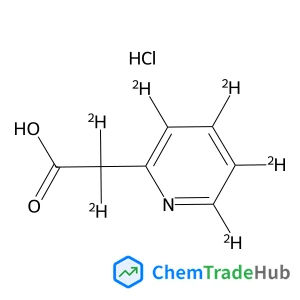
2,2-dideuterio-2-(3,4,5,6-tetradeuterio-2-pyridyl)acetic acid;hydrochloride
CAS番号:
1329799-67-8
分子式:
C7H2ClD6NO2

おすすめサプライヤー





免責事項
このページに表示される学術雑誌情報は、参考および研究目的のみを目的としています。当社は雑誌出版社とは提携しておらず、投稿の取り扱いも行っておりません。出版に関するお問い合わせは、各雑誌出版社に直接ご連絡ください。
表示されている情報に誤りがある場合は、support@chemtradehub.com までご連絡ください。迅速に確認し、対応いたします。