


Molecular dynamics simulations of N,N,N,N-tetramethylammonium dicyanamide plastic crystal and liquid using a polarizable force field
文献情報
出版日
2010-03-12
DOI
10.1039/B925946E
インパクトファクター
3.676
著者
Justin B. Hooper, Oleg Borodin
原文を見る
要旨
A quantum chemistry based, dipole polarizable force field has been used to simulate the N,N,N,N-tetramethylammonium (TMA) dicyanamide (DCA) ionic salt, in both plastic crystalline and liquid phases. Simulations predicted the [TMA][DCA] crystal structure and dimensions in good agreement with experiment. Ion–counterion spatial distributions are used to understand the local environment and ion pairing of both ions in crystalline and liquid phases. The rotational dynamics of ions in the crystalline system are thoroughly explored. Arrest of the DCA rotational degrees of freedom was associated with the experimentally observed solid–solid phase transitions. The self-diffusion coefficient and conductivity were calculated for the liquid state; however no net ion diffusion is noted in the pristine crystalline state. Introduction of ion vacancy at 0.3% concentration is found to be sufficient to enable ion diffusive behavior and conduction at 425 K in the crystalline state, with good agreement found between the experimental and simulated conductivity.
おすすめジャーナル

Advanced Engineering Materials

Contact Lens & Anterior Eye

Journal of Enzyme inhibition and Medicinal Chemistry

Photochemical & Photobiological Sciences

Environmental Toxicology and Pharmacology

Molecular Diversity

Lab on a Chip

Current Pharmaceutical Biotechnology

European Journal of Organic Chemistry

Foundations of Chemistry
関連文献
FTIR imaging of the molecular burden around Aβ deposits in an early-stage 3-Tg-APP-PSP1-TAU mouse model of Alzheimer's disease
Artur Dawid Surowka, Herve Boutin, Lidan Christie, Magdalena Szczerbowska-Boruchowska
2016-11-28
Paper
DOI: 10.1039/C6AN01797E
Graphite nanoparticle as nanoquencher for 17β-estradiol detection using shortened aptamer sequence
Xiaoli Qi, Hui Hu, Yunxian Piao
2018-07-18
Paper
DOI: 10.1039/C8AN00591E
Strategies for large-scale targeted metabolomics quantification by liquid chromatography-mass spectrometry
Juntuo Zhou, Yuxin Yin
2016-09-26
Critical Review
DOI: 10.1039/C6AN01753C
An ultrasensitive electrochemical immunosensor based on the synergistic effect of quaternary Cu2SnZnS4 NCs and cyclodextrin-functionalized graphene
Lei Liu, Yihe Zhang, Ruifeng Du, Jinhong Li, Xuelian Yu
2017-01-17
Paper
DOI: 10.1039/C6AN02538B
Detection of evoked acetylcholine release in mouse brain slices
R. Asri, B. O'Neill, J. C. Patel, K. A. Siletti, M. E. Rice
2016-10-03
Paper
DOI: 10.1039/C6AN01758D
Assay for Listeria monocytogenes cells in whole blood using isotachophoresis and recombinase polymerase amplification
Charbel Eid, Juan G. Santiago
2016-12-01
Communication
DOI: 10.1039/C6AN02119K
Ultrasensitive detection of nucleic acids based on dually enhanced fluorescence polarization
Bin Wang, Dahai Ren, Zheng You, Yaxiaer Yalikun, Yo Tanaka
2018-06-08
Paper
DOI: 10.1039/C8AN00952J
こちらもおすすめ
化合物よくある質問
4-アミノフェノール酸ナトリウム水和物とは何ですか?
4-アミノフェノール酸ナトリウム水和物は、CAS番号206557-08-6の化合物で、4-アミノフェノールとナトリウムが結合した塩と水和物です。この化合物は、白...
206557-08-64-Aminobenzoic acid ...
化合物よくある質問
Methyl 3-methyl-N-{[(2-methyl-2-propanyl)oxy]carbonyl}-L-histidinateの代替品はありますか?
この化合物は特定の合成プロセスに使用される可能性がありますが、代替品として、他の类似的な化合物、例えばMethyl 3-methyl-N-{[(2-methyl...
72212-51-2Methyl 3-methyl-N-{[...
化合物よくある質問
4-Boc-2-哌嗪甲酸の市場動向や研究トレンドはどうですか?
4-Boc-2-哌嗪甲酸は、薬品開発や合成化学分野で広く使用されており、その需要は継続的に推移しています。特に、新薬開発における合成化学分野での需要が高まってい...
192330-11-3(2R)-4-[(tert-butoxy...
化合物よくある質問
4,4'-二羟甲基联苯の物理化学的性質は何ですか?
4,4'-二羟甲基联苯のCAS番号は1667-12-5です。この化合物は白色の結晶粉末で、分子量は154.20です。水にわずかに溶けますが、アルコールや有機溶媒...
1667-12-54,4'-Biphenyldiyldim...
化合物よくある質問
5-甲硫基戊腈はどの業界で使用されていますか?
5-甲硫基戊腈は医薬品産業で使用される可能性があります。また、ポリマー合成の触媒として、センサー製造の一部として、半導体製造のプロセス改善に使用される可能性があ...
59121-25-45-(Methylsulfanyl)pe...
化合物よくある質問
CAS番号1311961-50-8の化合物はどのように合成されますか?
この化合物は、1-abieta-8,11,13-trien-19-イルと6'-メトキシシンコナナン-9-基を含有する窒素含有化合物から合成されます。一般的な合成...
1311961-50-81-Abieta-8,11,13-tri...
化合物よくある質問
6-ブロモベンジジミダゾール-2-カルビルデオキシドはどのように保存すればよいですか?
6-ブロモベンジジミダゾール-2-カルビルデオキシドは、避光・乾燥した容器(密閉容器)で-20℃~4℃の低温で保存してください。高温や直射日光、湿気は避けてくだ...
885280-26-25-Bromo-1H-benzimida...
化合物よくある質問
Boc-N-甲基氨甲环酸とは何ですか?
621-65-8のCAS番号を持つBoc-N-甲基氨甲环酸は、化学式C7H13NO5を有する化合物です。この化合物は白色の結晶性粉末で、吸湿性があります。
621-65-83-Hydroxy-1,2-propan...
化合物よくある質問
乙基三氟硼酸钾はどのように合成されますか?
乙基三氟硼酸钾は、トリフLUオール酸カリウムとエチルブロミドを反応させて合成されます。この反応は高い選択性と収率を持ち、触媒を用いることで効率的に進行します。
882871-21-8Potassium ethyltrifl...
化合物よくある質問
2-フロウロ-5-クロロ-4-アミノフェノールはどのように保存すればよいですか?
2-フロウロ-5-クロロ-4-アミノフェノールは、直射日光を避けて冷却された暗所で保存し、密閉容器に保管してください。温度は常温か低温が適しています。
847872-10-04-Amino-5-chloro-2-f...
掲載誌
Physical Chemistry Chemical Physics

CiteScore:
5.5
自己引用率:
10.3%
年間論文数:
3036
Physical Chemistry Chemical Physics (PCCP) is an international journal co-owned by 19 physical chemistry and physics societies from around the world. This journal publishes original, cutting-edge research in physical chemistry, chemical physics and biophysical chemistry. To be suitable for publication in PCCP, articles must include significant innovation and/or insight into physical chemistry; this is the most important criterion that reviewers and Editors will judge against when evaluating submissions. The journal has a broad scope and welcomes contributions spanning experiment, theory, computation and data science. Topical coverage includes spectroscopy, dynamics, kinetics, statistical mechanics, thermodynamics, electrochemistry, catalysis, surface science, quantum mechanics, quantum computing and machine learning. Interdisciplinary research areas such as polymers and soft matter, materials, nanoscience, energy, surfaces/interfaces, and biophysical chemistry are welcomed if they demonstrate significant innovation and/or insight into physical chemistry. Joined experimental/theoretical studies are particularly appreciated when complementary and based on up-to-date approaches.
おすすめ化合物
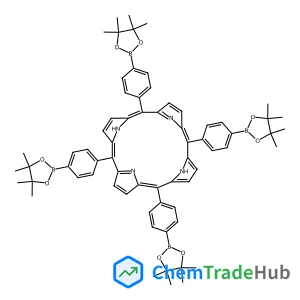
5,10,15,20-tetrakis(4-boronic acid pinacol ester phenyl) porphyrin
CAS番号:
1332748-00-1
分子式:
C68H74B4N4O8
おすすめサプライヤー



免責事項
このページに表示される学術雑誌情報は、参考および研究目的のみを目的としています。当社は雑誌出版社とは提携しておらず、投稿の取り扱いも行っておりません。出版に関するお問い合わせは、各雑誌出版社に直接ご連絡ください。
表示されている情報に誤りがある場合は、support@chemtradehub.com までご連絡ください。迅速に確認し、対応いたします。