












Micro-FTIR study of soot chemical composition—evidence of aliphatic hydrocarbons on nascent soot surfaces
文献情報
出版日
2010-03-19
DOI
10.1039/B924344E
インパクトファクター
3.676
著者
Jeremy P. Cain, Paul L. Gassman, Hai Wang, Alexander Laskin
原文を見る
要旨
Previous studies suggest that soot formed in premixed flat flames can contain a substantial amount of aliphatic compounds. Presence of these compounds may affect the kinetics of soot mass growth and oxidation in a way that is currently not understood. Using an infrared spectrometer coupled to a microscope (micro-FTIR), we examined the composition of soot sampled from a set of ethylene–argon–oxygen flames recently characterized (A. D. Abid, et al. Combust. Flame, 2008, 154, 775–788), all with an equivalence ratio ϕ = 2.07 but varying in maximum flame temperatures. Soot was sampled at three distances above the burner surface using a probe sampling technique and deposited on silicon nitride thin film substrates using a cascade impactor. Spectra were taken and analyses performed for samples collected on the lowest five impactor stages with the cut-off sizes of D50 = 10, 18, 32, 56 and 100 nm. The micro-FTIR spectra revealed the presence of aliphatic C–H, aromatic C–H and various oxygenated functional groups, including carbonyl (CO), C–O–C and C–OH groups. Spectral analyses were made to examine variations of these functional groups with flame temperature, sampling position and particle size. Results indicate that increases in flame temperature leads to higher contents of non-aromatic functionalities. Functional group concentrations were found to be ordered as follows: [CO] < [C–O] < [aliphatic C–H]. Aliphatic C–H was found to exist in significant quantities, with very little oxygenated groups present. The ratio of these chemical functionalities to aromatic C–H remains constant for particle sizes spanning 10–100 nm. The results confirm a previous experimental finding: a significant amount of aliphatic compounds is present in nascent soot formed in the flames studied, especially towards larger distances above the burner surface.
関連文献
A sub-picomolar assay for protein by using cubic Cu2O nanocages loaded with Au nanoparticles as robust redox probes and efficient non-enzymatic electrocatalysts
Jianmin Zhao, Ting Zheng, Jiaxi Gao, Shijing Guo, Xingxing Zhou, Wenju Xu
2017-01-16
Paper
DOI: 10.1039/C6AN02599D
Graphite nanoparticle as nanoquencher for 17β-estradiol detection using shortened aptamer sequence
Xiaoli Qi, Hui Hu, Yunxian Piao
2018-07-18
Paper
DOI: 10.1039/C8AN00591E
Assessment of coulometric array electrochemical detection coupled with HPLC-UV for the absolute quantitation of pharmaceuticals
Michael B. Hicks, Leah Salituro, Ian Mangion, Wes Schafer, Rong Xiang, Xiaoyi Gong, Christopher J. Welch
2017-01-18
Paper
DOI: 10.1039/C6AN02432G
A novel miniaturized biofilter based on silicon micropillars for nucleic acid extraction
Salvatore Petralia, Emanuele Luigi Sciuto, Sabrina Conoci
2016-11-21
Paper
DOI: 10.1039/C6AN02049F
Orientational binding modes of reporters in a viral-nanoparticle lateral flow assay
Jinsu Kim, Ryan Poling-Skutvik, João R. C. Trabuco, Katerina Kourentzi, Jacinta C. Conrad
2016-09-26
Paper
DOI: 10.1039/C6AN00567E
Rapid capillary mixing experiments for the analysis of hydrophobic membrane complexes directly from aqueous lipid bilayer solutions
John W. Patrick, Breanna Zerfas, Jianmin Gao, David H. Russell
2016-12-08
Paper
DOI: 10.1039/C6AN02290A
Polymer-mediated ternary supramolecular interactions for sensitive detection of peptides
Mahalia A. C. Serrano, Huan He, Bo Zhao, Rajasekhar R. Ramireddy, Richard W. Vachet, S. Thayumanavan
2016-11-02
Paper
DOI: 10.1039/C6AN01591C
Rapid visualization of macromolecular orientation by discrete frequency mid-infrared spectroscopic imaging
Tomasz P. Wrobel
2016-10-13
Paper
DOI: 10.1039/C6AN01086E
Metal oxide semiconductor SERS-active substrates by defect engineering
Hao Wu
2016-11-23
Paper
DOI: 10.1039/C6AN01959E
Raman spectrum identification based on the correlation score using the weighted segmental hit quality index
Jun-Kyu Park, Aaron Park, Si Kyung Yang, Sung-June Baek, Joonki Hwang, Jaebum Choo
2016-12-20
Paper
DOI: 10.1039/C6AN02315K
こちらもおすすめ
化合物よくある質問
4-アミノフェノール酸ナトリウム水和物とは何ですか?
4-アミノフェノール酸ナトリウム水和物は、CAS番号206557-08-6の化合物で、4-アミノフェノールとナトリウムが結合した塩と水和物です。この化合物は、白...
206557-08-64-Aminobenzoic acid ...
化合物よくある質問
Methyl 3-methyl-N-{[(2-methyl-2-propanyl)oxy]carbonyl}-L-histidinateの代替品はありますか?
この化合物は特定の合成プロセスに使用される可能性がありますが、代替品として、他の类似的な化合物、例えばMethyl 3-methyl-N-{[(2-methyl...
72212-51-2Methyl 3-methyl-N-{[...
化合物よくある質問
4-Boc-2-哌嗪甲酸の市場動向や研究トレンドはどうですか?
4-Boc-2-哌嗪甲酸は、薬品開発や合成化学分野で広く使用されており、その需要は継続的に推移しています。特に、新薬開発における合成化学分野での需要が高まってい...
192330-11-3(2R)-4-[(tert-butoxy...
化合物よくある質問
4,4'-二羟甲基联苯の物理化学的性質は何ですか?
4,4'-二羟甲基联苯のCAS番号は1667-12-5です。この化合物は白色の結晶粉末で、分子量は154.20です。水にわずかに溶けますが、アルコールや有機溶媒...
1667-12-54,4'-Biphenyldiyldim...
化合物よくある質問
5-甲硫基戊腈はどの業界で使用されていますか?
5-甲硫基戊腈は医薬品産業で使用される可能性があります。また、ポリマー合成の触媒として、センサー製造の一部として、半導体製造のプロセス改善に使用される可能性があ...
59121-25-45-(Methylsulfanyl)pe...
化合物よくある質問
CAS番号1311961-50-8の化合物はどのように合成されますか?
この化合物は、1-abieta-8,11,13-trien-19-イルと6'-メトキシシンコナナン-9-基を含有する窒素含有化合物から合成されます。一般的な合成...
1311961-50-81-Abieta-8,11,13-tri...
化合物よくある質問
6-ブロモベンジジミダゾール-2-カルビルデオキシドはどのように保存すればよいですか?
6-ブロモベンジジミダゾール-2-カルビルデオキシドは、避光・乾燥した容器(密閉容器)で-20℃~4℃の低温で保存してください。高温や直射日光、湿気は避けてくだ...
885280-26-25-Bromo-1H-benzimida...
化合物よくある質問
Boc-N-甲基氨甲环酸とは何ですか?
621-65-8のCAS番号を持つBoc-N-甲基氨甲环酸は、化学式C7H13NO5を有する化合物です。この化合物は白色の結晶性粉末で、吸湿性があります。
621-65-83-Hydroxy-1,2-propan...
化合物よくある質問
乙基三氟硼酸钾はどのように合成されますか?
乙基三氟硼酸钾は、トリフLUオール酸カリウムとエチルブロミドを反応させて合成されます。この反応は高い選択性と収率を持ち、触媒を用いることで効率的に進行します。
882871-21-8Potassium ethyltrifl...
化合物よくある質問
2-フロウロ-5-クロロ-4-アミノフェノールはどのように保存すればよいですか?
2-フロウロ-5-クロロ-4-アミノフェノールは、直射日光を避けて冷却された暗所で保存し、密閉容器に保管してください。温度は常温か低温が適しています。
847872-10-04-Amino-5-chloro-2-f...
掲載誌
Physical Chemistry Chemical Physics

CiteScore:
5.5
自己引用率:
10.3%
年間論文数:
3036
Physical Chemistry Chemical Physics (PCCP) is an international journal co-owned by 19 physical chemistry and physics societies from around the world. This journal publishes original, cutting-edge research in physical chemistry, chemical physics and biophysical chemistry. To be suitable for publication in PCCP, articles must include significant innovation and/or insight into physical chemistry; this is the most important criterion that reviewers and Editors will judge against when evaluating submissions. The journal has a broad scope and welcomes contributions spanning experiment, theory, computation and data science. Topical coverage includes spectroscopy, dynamics, kinetics, statistical mechanics, thermodynamics, electrochemistry, catalysis, surface science, quantum mechanics, quantum computing and machine learning. Interdisciplinary research areas such as polymers and soft matter, materials, nanoscience, energy, surfaces/interfaces, and biophysical chemistry are welcomed if they demonstrate significant innovation and/or insight into physical chemistry. Joined experimental/theoretical studies are particularly appreciated when complementary and based on up-to-date approaches.
おすすめ化合物
![[3-(2,6-Dichlorophenyl)-5-isopropyl-1,2-oxazol-4-yl]methanol structure](https://static.chemtradehub.com/structs/278/278597-30-1-5c79.webp "[3-(2,6-Dichlorophenyl)-5-isopropyl-1,2-oxazol-4-yl]methanol structure")
![2-[(5Z,8Z,11Z,14Z)-5,8,11,14-Icosatetraen-1-yloxy]-1,3-propanediol structure](https://static.chemtradehub.com/structs/222/222723-55-9-0348.webp "2-[(5Z,8Z,11Z,14Z)-5,8,11,14-Icosatetraen-1-yloxy]-1,3-propanediol structure")
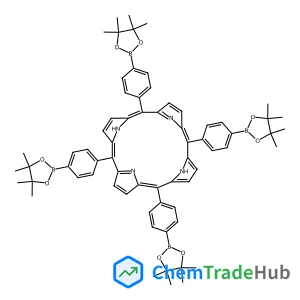
5,10,15,20-tetrakis(4-boronic acid pinacol ester phenyl) porphyrin
CAS番号:
1332748-00-1
分子式:
C68H74B4N4O8
おすすめサプライヤー






免責事項
このページに表示される学術雑誌情報は、参考および研究目的のみを目的としています。当社は雑誌出版社とは提携しておらず、投稿の取り扱いも行っておりません。出版に関するお問い合わせは、各雑誌出版社に直接ご連絡ください。
表示されている情報に誤りがある場合は、support@chemtradehub.com までご連絡ください。迅速に確認し、対応いたします。